

How to launch an app successfully in 2026?
Success in 2026 requires a technical-first approach: verify backend scalability via containerization, optimize ASO for AI-driven discovery, and implement predictive retention loops. A successful launch is a multi-phase process involving validation, infrastructure hardening, and cross-channel growth coordination.
The mobile app market in 2026 is defined by a paradox. While it has never been easier to build an application using high-level frameworks and AI-assisted coding, it has never been harder to actually succeed. Launching an app today requires more than just pushing code to a production server or hitting the "Submit" button in App Store Connect. You need a strategy that covers technical validation, market positioning, and growth loops that run themselves.
If you're planning on launching app versions of your business logic, you have to understand that the "launch" isn't a single event. It's a process that starts months before the first line of code and keeps going long after the download link is live. This guide provides the technical and strategic framework needed to handle this process in the current AI-driven environment. (It’s a process most teams skip — and it shows.)
- The 2026 technical requirements for server-side scalability
- How AI-driven discovery is changing App Store Optimization (ASO)
- A step-by-step framework for Beta testing and validation
- The critical KPIs (Retention, LTV:CAC) for modern app growth
- Global distribution strategies and compliance requirements
- How to leverage AI for predictive user onboarding
What Is Launching an App? (Definition & Importance)
In a technical sense, launching an app is the transition from a private development environment to a public, production-ready state. However, from a business perspective, the definition is much broader. Launching an app is the execution of a go-to-market strategy designed to acquire, engage, and retain users from Day 1. (This definition is the foundation of any successful project.)
You can't ignore the importance of a structured strategy for launching app versions. It’s the difference between a top-tier product and a ghost town. According to data from Statista (2025), over 25% of mobile applications are opened only once after being downloaded. This "one-and-done" problem usually happens when a launch fails to show value or creates a clunky first impression. In 2026, where users have thousands of alternatives at their fingertips, you can't afford a weak start.
The 2026 App Ecosystem
The current mobile world is heavily influenced by AI-driven discovery. App stores now use advanced machine learning algorithms to suggest applications based on granular user behavior rather than just category rankings. This means that your metadata, initial review velocity, and retention metrics are more critical than ever.
A successful launch guarantees that these algorithms favor your app early, creating a positive feedback loop of organic growth. At UseShift, we view the launch as the first major stress test of your custom AI workflows. If your backend cannot handle the initial surge or if your user onboarding is friction-heavy, the market will punish you immediately. This is why we prioritize architectural stability alongside marketing flair.
The Pre-Launch Phase: Validating Your Application Idea

Before you even think about the technical aspects of releasing your build, you have to validate that the problem you are solving actually exists. Many founders skip this step. They assume their "unique" idea will find its own audience. That’s the fastest way to burn your budget. (We've seen it happen time and again.)
Market Research with AI Tools
In 2026, market research is no longer about reading static reports. It involves using AI to analyze sentiment across social platforms, identifying gaps in competitor reviews, and simulating user demand. You should look for "unmet needs" in current top-tier applications. If B2B SaaS teams are complaining about the lack of specific automation in a competitor's tool, that's your entry point.
Using large language models to categorize thousands of App Store reviews from your competitors can reveal exactly where they are failing. Are their users complaining about slow load times? Is the navigation confusing? By addressing these pain points in your own launch, you position your app as the superior alternative from the first day.
Beta Testing and Feedback Loops
Releasing app builds to a closed group, often called a "Beta" or "Pilot" phase, is mandatory. This is where you test your core assumptions. Using platforms like TestFlight (iOS) or Google Play Console Beta (Android), you can distribute your app to a controlled group of 100 to 1,000 users.
The goal here isn't just to find bugs. You're looking for "Value Confirmation." Are users using the features you thought were important? If they're ignoring your primary feature but spending hours on a secondary tool, you need to pivot your marketing before the grand launch. This is the same principle we apply when building a blueprint application for our clients: validate the architecture through usage, not just theory.
Pro-Tip: Sentiment Extraction
Use AI to scrape and summarize the 1-star reviews of your top 3 competitors. Build those missing features or fix those specific bugs before your own launch to gain an immediate competitive edge.
Technical Infrastructure: Preparing Your App for Scale
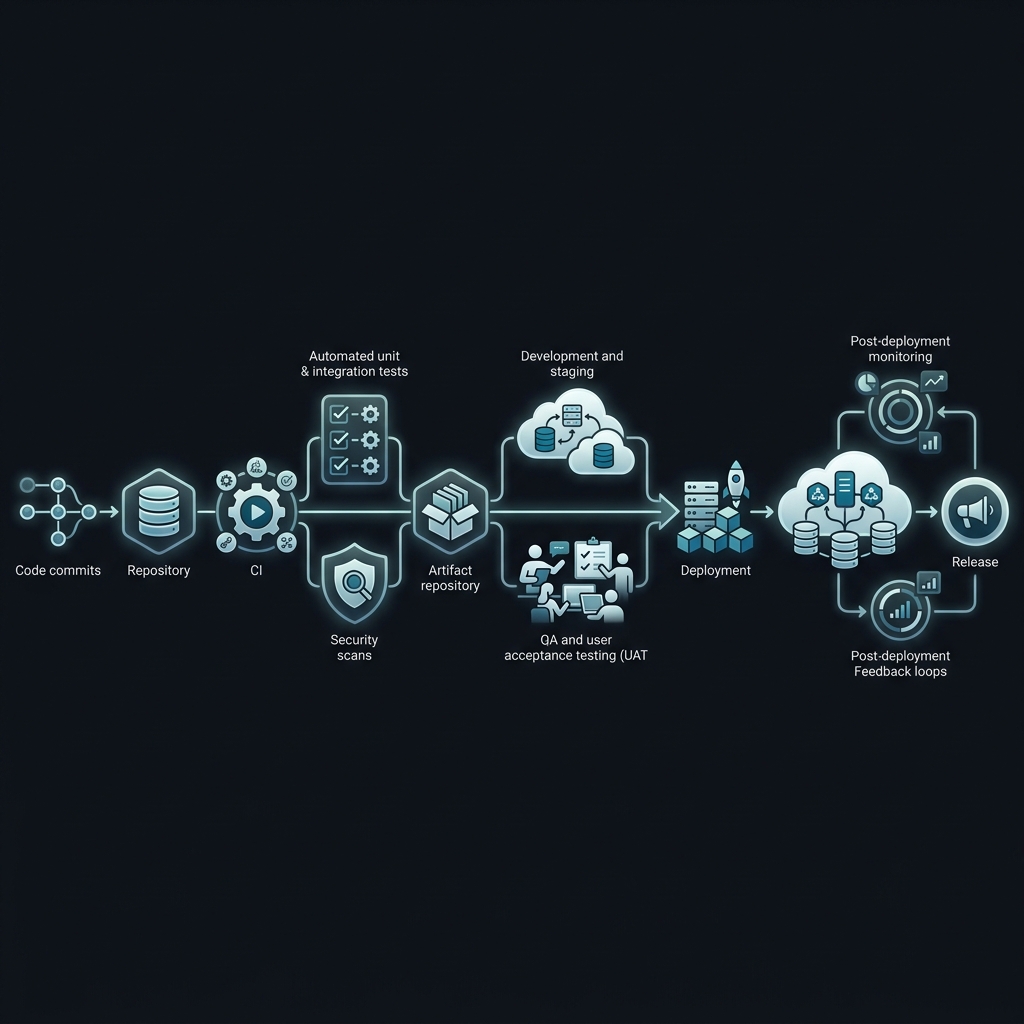
A failed launch is often a technical failure. If your app crashes because 5,000 users joined simultaneously, your reputation will suffer a blow that is difficult to recover from. Preparing your infrastructure is a non-negotiable part of the deployment process.
Server-Side Readiness and Autoscaling
Your backend must be elastic. In 2026, using static server instances for a launch is a high-risk move. You should utilize container orchestration platforms like Kubernetes or managed services like AWS ECS to verify your API can scale horizontally as traffic spikes. We often recommend teams look into AWS ECS vs Kubernetes comparisons to decide which fits their internal engineering capacity.
If you are building a data-heavy or AI-reliant application, your latency is your biggest enemy. Confirm your model inference is optimized and that you are using edge caching (like Cloudflare or Akamai) to serve static assets and even dynamic API responses where possible.
Monitoring, Analytics, and Telemetry
You cannot fix what you cannot see. Before launching app updates or the initial build, you have to have a full observability stack in place. This includes:
- Crash Reporting: Tools like Sentry or Firebase Crashlytics to catch real-time exceptions.
- Product Analytics: Platforms like Mixpanel or Amplitude to track user journeys.
- Infrastructure Monitoring: Datadog or Prometheus to monitor server health and API latency.
- User Feedback Loops: In-app triggers that ask for feedback after a successful "aha moment."
At UseShift, we integrate these telemetry layers directly into our AI software development company workflows. We believe that data-driven iteration is the only way to sustain growth after the initial hype fades.
Comparison: Launching App on App Store vs. Google Play Store
While cross-platform frameworks like Ionic or Flutter allow you to use a single codebase, the release process for each store remains distinct. Understanding these differences is necessary for your project timeline.
| Feature | Apple App Store (iOS) | Google Play Store (Android) |
|---|---|---|
| Submission Process | Strict manual review of every build. | Mostly automated; faster reviews. |
| Review Duration | 24 - 48 hours (average). | 1 - 4 hours to 3 days. |
| Optimization (ASO) | Focus on Title/Subtitle; hidden keywords. | Focus on Title/Long Description. |
| User Acquisition Cost | Higher (High-LTV users). | Lower (Greater global volume). |
| Monetization Trend | High subscription conversion. | High ad-revenue and microtransactions. |
Navigating the Review Process
Apple is notoriously protective of its ecosystem. If you are releasing app versions that use private APIs or have unclear subscription terms, you will be rejected. Google, while more permissive in the past, has significantly increased its security requirements in 2026. Both platforms now require a "Privacy Manifest" that explains exactly how you handle user data, especially when using AI models.
Step-by-Step Guide to a Successful App Launch
Follow this sequence to verify no detail is missed during the release lifecycle.
1. Final Quality Assurance (QA)
This is the "Zero-Bug" phase. Use automated testing suites to verify your core flows. If your "Sign Up" or "Payment" flow has even a minor glitch, your conversion rate will plummet. We recommend using Playwright or Vitest for stable, automated verification of your application logic.
2. App Store Optimization (ASO)
ASO is the SEO of the mobile world. You need:
- High-Impact Screenshots: Don't just show the UI. Show the benefit. Use text overlays to explain what the user is seeing.
- Preview Videos: A 15-second video of the app in action is worth more than ten static images.
- Keyword Strategy: Use tools like AppTweak or SensorTower to find low-competition, high-volume keywords. For instance, look for specific long-tail keywords like "AI task prioritizer" instead of just "productivity."
3. The "Soft Launch" Strategy
Before you tell the whole world, launch in a smaller, representative market (e.g., Canada, Australia, or New Zealand). This allows you to gather real-world data on your Cost Per Install (CPI) and Lifetime Value (LTV) without "wasting" your primary market on an unoptimized build.
4. The Grand Launch Coordination
A grand launch is a multi-channel effort. Synchronize your PR, social media, and email marketing. Contact niche tech journalists and influencers two weeks in advance. Provide them with a "Media Kit" (logos, screenshots, and a summary).
5. Real-Time Performance Monitoring
During the first 48 hours, your team should be in "War Room" mode. Monitor your analytics constantly. If you see a high drop-off at a specific screen, you might have a UI bug or a confusing instruction. Be prepared to push an emergency update.
The Role of AI in Modern App Launches (2026 Perspective)
In 2026, releasing application versions without integrated AI is essentially launching legacy software. AI isn't just a "feature." It's the engine that drives discovery, engagement, and operational efficiency.
AI-Driven App Discovery
Both Apple Intelligence and Google's Gemini-powered Play Store now use semantic search. Your app store description shouldn't just be a list of keywords. It should be a coherent narrative that explains how your app solves complex problems. When a user asks their phone, "Help me organize my work week," the AI looks for applications that have documented success in "autonomous task management."
On-Device vs. Cloud AI During Launch
One of the most critical decisions is where your AI "lives." On-device AI provides lower latency and better privacy. Cloud AI allows for more complex models. We often guide our clients toward a hybrid approach: using on-device models for immediate UI responsiveness while offloading heavy data processing to a custom AI workflow in the cloud.
Predictive User Onboarding
AI can personalize the onboarding experience in real-time. If the AI detects a "Power User," it can skip basic tutorials. Conversely, if a user is struggling, the AI can trigger a proactive chat helper. This reduces the Day 1 churn rate, which is the single biggest killer of new applications.
Measuring Success: KPIs That Matter in 2026
When launching an application, you have to know what success looks like beyond simple download counts. Downloads are a "vanity metric." Retention and engagement are the "truth metrics."
1. Day 1, Day 7, and Day 30 Retention
Industry benchmarks (2026): a "Good" Day 1 retention rate for a B2B app is 40%. If you are below 25%, your onboarding is failing. Day 30 retention tells you if your app has become a habit. In the world of SaaS solutions, anything above 15% at Day 30 is a strong indicator of long-term viability.
2. CAC vs. LTV (The Golden Ratio)
Your Cost Per Acquisition (CAC) must be lower than your Lifetime Value (LTV). Ideally, you want a 3:1 ratio. If you spend $5.00 to acquire a user, that user must generate at least $15.00 in profit over their lifetime.
3. Active Time and Session Frequency
How often do users return? Monitoring these patterns in the first 48 hours allows you to adjust your push notification strategy immediately.
4. Viral Coefficient (K-Factor)
Does one user bring in another? If your K-factor is 1.0, your app is growing organically. Most apps hover around 0.1 or 0.2. To increase this, build "Network Effects" into the launch, such as an "Invite a Colleague" button with mutual benefits.
Global Distribution: Launching in International Markets
Releasing application builds globally isn't just about translating text. It’s about cultural adaptation and regional technical requirements.
Localization vs. Internationalization
Internationalization is the technical foundation (currencies, date formats). Localization is the cultural layer (screenshots, tone). In 2026, AI makes this easier, but you should still have a native speaker review the final output to avoid cultural faux pas.
Regional Compliance (GDPR, CCPA, and Beyond)
GDPR compliance is mandatory for Europe. China requires different app stores and regulatory steps. Failure to comply can lead to your app being pulled without warning. We recommend integrating a "Compliance as Code" layer into your DevOps consulting strategy.
Security and Compliance: Mandatory Launch Requirements
In the age of autonomous agents, security is a primary concern. You can't launch an app in 2026 without a "Zero-Trust" security architecture.
Data Privacy Manifests
Apple and Google now require machine-readable files declaring data collection. If your app uses third-party SDKs, you're responsible for their data practices too. Verify your legal and engineering teams are in sync.
Biometric Authentication and Encryption
Users expect FaceID or Android Biometrics as standard. All data at rest and in transit must be encrypted using AES-256 or better. At UseShift, we prioritize security in every AI software development project.
Post-Launch Marketing: How to Sustain Growth
The launch is just the beginning. The real work is keeping the users you just paid to acquire.
User Retention and the "Next 30 Days"
The first 30 days are critical. Use push notifications sparingly to remind users of value they haven't explored yet. UseShift specializes in building automated marketing workflows that handle this lifecycle.
Community Building: Beyond the Initial Download
In 2026, successful apps build communities (Discord, Slack). When releasing updates, announce them to your community first to create a group of "Super Users" who defend your app in reviews.
Iterative Updates: The Pulse of Success
Aim for a bi-weekly update cycle. Even minor bug fixes show users and algorithms the app is alive. The "What's New" section is a prime marketing opportunity.
Common Mistakes When Launching an Application
Skipping the Beta Phase
Releasing to the public without a beta test is gambling. You'll miss edge cases that only appear in the wild. A beta phase is your insurance policy.
Poor ASO Strategy
If you don't show up in search, you're relying entirely on expensive paid ads. Treat your store page like a high-performance landing page.
Conclusion
Launching an app is a complex engineering and marketing feat. In 2026, the margin for error is slim. But the opportunity for scale is unprecedented. By focusing on technical stability, early validation, and a structured ASO strategy, you can move from a "built" application to a "successful" one.
The current environment is shifting toward autonomous, AI-driven experiences. Whether you're building a tool for SaaS users or a custom internal utility, your launch strategy has to be as modern as your code. The integration of predictive analytics and on-device AI isn't optional. It's the baseline for user expectation.
Key Takeaways
- A successful launch in 2026 is a multi-phase validation and growth process, not a single event.
- Technical scalability and ASO optimized for AI discovery are the non-negotiable foundations.
- Long-term success depends on Day-30 retention and maintaining a 3:1 LTV:CAC ratio.
- AI is the engine for modern user onboarding, discovery, and operational efficiency.