

What is DevOps Consulting?
DevOps consulting is a professional service that optimizes your software delivery lifecycle by integrating development and operations through automation (IaC, CI/CD), security shifting left (DevSecOps), and cloud strategy. It transforms manual, brittle infrastructure into autonomous, high-velocity systems that drive ROI.
The engineering landscape of 2026 is no longer defined by the speed of code completion but by the reliability of code delivery. For most scaling enterprises, the bottleneck is rarely a lack of developers; it is the friction between the keyboard and the production environment. This is where devops consulting has transitioned from a luxury for tech giants to a survival requirement for any business operating in a cloud-native world.
In the early days of the DevOps movement, the focus was primarily on breaking down the literal wall between development and operations teams. Today, that wall has been replaced by a complex web of distributed systems, serverless architectures, and AI-driven automation layers. A modern devops strategy is no longer just about "automating the boring stuff." It is about building an autonomous infrastructure that allows your engineering team to focus entirely on product innovation while the system handles its own scaling, healing, and security.
At UseShift, we have observed that the most successful digital transformations do not start with a new tool. They start with a fundamental shift in how infrastructure is perceived: as a product, not a utility. This guide explores the deep mechanics of devops engineering, the ROI of professional intervention, and the roadmap for transitioning from manual overhead to high-velocity automation.
- The redefined role of DevOps consultants in the 2026 cloud-native ecosystem
- How Infrastructure as Code (IaC) eliminates "snowflake servers"
- Strategic CI/CD optimization for 10x engineering velocity
- A proven 5-step framework for complete DevOps transformation
- Calculating the real ROI of DevOps through DORA metrics and cloud cost reduction
- Why AI-driven Observability is replacing traditional monitoring
What is DevOps Consulting?
Devops consulting is a professional service that helps organizations optimize their software delivery lifecycle by integrating development and operations through automation, cultural alignment, and strategic tooling. Unlike traditional IT outsourcing, devops consulting focuses on building internal capabilities and automated systems that allow for continuous integration and continuous deployment (CI/CD) with minimal human intervention.
In 2026, the definition has expanded. A devops consultant is now expected to be an architect of efficiency. They do not just "set up a server." They design self-reconciling systems where the desired state of the infrastructure is defined as code and enforced by autonomous agents. This shift from imperative management (doing things) to declarative management (defining things) is the core value proposition of professional devops implementation.
The market value for this expertise has skyrocketed. With a cost-per-click (CPC) often exceeding $80 for keywords like "devops consulting," it is clear that businesses recognize the massive financial impact of getting their infrastructure right. A single failed deployment or a poorly optimized cloud spend can cost a company millions. Investing in a professional devops audit is often the difference between a scalable product and a technical debt trap.
The Role of a Modern DevOps Consultant
A devops consultant serves as the bridge between business objectives and technical execution. Their role is multifaceted, requiring a blend of high-level architecture design and hands-on engineering excellence. They are the guardians of the production environment and the enablers of developer productivity.
Infrastructure as Code (IaC) Architecture
The foundation of any modern devops strategy is Infrastructure as Code. In 2026, tools like Terraform and Pulumi have become the industry standard. A devops consultant ensures that every resource, from a simple S3 bucket to a complex Kubernetes cluster, is version-controlled and reproducible.
This eliminates the risk of "snowflake servers"—environments that are manually configured and impossible to replicate. By treating infrastructure as software, companies can apply the same rigorous testing and review processes to their servers as they do to their application code. We often see teams struggling with manual changes made in the AWS Console (ClickOps); our role is to codify those changes into modular, reusable HCL (HashiCorp Configuration Language) or TypeScript components. This modularity allows for the rapid spinning up of ephemeral environments for testing, significantly reducing the time it takes to validate new features.
CI/CD Pipeline Optimization
Velocity is the primary metric for engineering success. A devops consultant analyzes existing deployment pipelines to identify bottlenecks. Whether it is slow test suites, manual approval gates, or flaky build environments, the goal is always the same: reduce the lead time for changes. See our list of the best CI/CD tools for 2026.
By implementing advanced CI/CD techniques using platforms like GitHub Actions or GitLab CI, consultants enable teams to move from weekly deployments to multiple deployments per day with complete confidence. This involves more than just scripting; it requires the design of "Pipeline-as-Code" that includes automated rollbacks, canary deployments, and feature flagging. At UseShift, we focus on the "Inner Loop" (the time it takes for a developer to see their changes reflected in a development environment) and the "Outer Loop" (the path to production), ensuring both are as frictionless as possible.
Security Integration (DevSecOps)
Security is no longer a checkbox at the end of the development cycle. In a world of increasing cyber threats, security must be "shifted left." A modern devops consultant integrates automated security scanning directly into the build process. This includes static analysis (SAST) using tools like SonarQube, dynamic analysis (DAST), and dependency scanning to catch vulnerable npm or Python packages.
By identifying vulnerabilities before code ever reaches production, companies can avoid the catastrophic reputational and financial damage of a data breach. We also implement "Secret Management" best practices, ensuring that API keys and database credentials are never hardcoded in repositories but are instead fetched at runtime from secure vaults like HashiCorp Vault or AWS Secrets Manager.
Cloud Native Strategy
Whether your organization is focused on aws devops, Azure, or Google Cloud, a consultant provides the expertise to navigate the specific nuances of each platform. They help decide between managed services like AWS ECS and the complexity of self-managed Kubernetes. For many teams, the right choice is a serverless-first approach that minimizes operational overhead.
A consultant also manages the "Cloud Spend Management" (FinOps) aspect of the strategy. This means not just building systems, but building them cost-effectively. We look at everything from Graviton instance migration on AWS to automated cleanup of detached EBS volumes and idle RDS instances.
Key Takeaways
- A DevOps consultant bridges the gap between business goals and technical reliability.
- Infrastructure as Code (IaC) is non-negotiable for reproducible deployments.
- DevSecOps ensures security is integrated into the code, not tacked on at the end.
The Human Element: DevOps Culture in 2026
While the technical aspects of devops engineering often take center stage, the cultural shift is what determines long-term success. A devops consultant acts as a change agent, breaking down the silos between departments.
DevOps is, at its heart, a culture of experimentation and psychological safety. In 2026, we emphasize "Blameless Post-Mortems." When a system fails—and all systems eventually fail—the focus is not on finding who made the mistake, but on finding the systemic weakness that allowed the mistake to occur. This culture encourages developers to take risks and innovate, knowing that the automated guardrails and rollback procedures are there to catch them.
Furthermore, we introduce the concept of "Platform Engineering." Instead of operations being a service desk for developers, the operations team builds a "Self-Service Platform." This allows developers to provision their own databases, caches, and compute nodes without waiting for a ticket to be resolved. This autonomy is the ultimate goal of any devops strategy.
The 5-Step DevOps Consulting Framework
At UseShift, we utilize a proven framework to transition companies from legacy bottlenecks to automated excellence. This process is designed to deliver immediate value while building a foundation for long-term scalability.
Step 1: The DevOps Audit & Assessment
You cannot optimize what you do not measure. The process begins with a comprehensive devops audit. We look at your current deployment frequency, change failure rate, and mean time to recovery. We utilize the DORA (DevOps Research and Assessment) metrics as our baseline.
Step 2: Strategy & Roadmap Design
Defining the future state. This involves selecting the right toolstack—perhaps choosing Pulumi over Terraform or opting for IaC patterns that align with your team's existing skills. The roadmap provides a clear, phased approach to transformation.
Step 3: Foundational Build-out
Execution phase. We build core IaC modules and initial CI/CD pipelines. We establish the 'Golden Path' for developers—a standardized, automated way to get code from a local machine to production.
Step 4: Cultural Transformation & Training
Upskilling the internal team. We conduct workshops on <Link to="/blog/gitops" style={{ color: 'var(--accent-primary)', textDecoration: 'underline' }}>GitOps</Link>, SRE principles, and cloud-native development. We don't just 'do it for you'; we 'do it with you' through pair programming and knowledge transfer.
Step 5: Continuous Monitoring & Iteration
Operational excellence. We implement advanced observability stacks using Datadog, Prometheus, or Grafana. We move beyond simple 'is it up?' to 'is it healthy?' aligned with business SLOs.
Comparative Analysis: Hiring Models
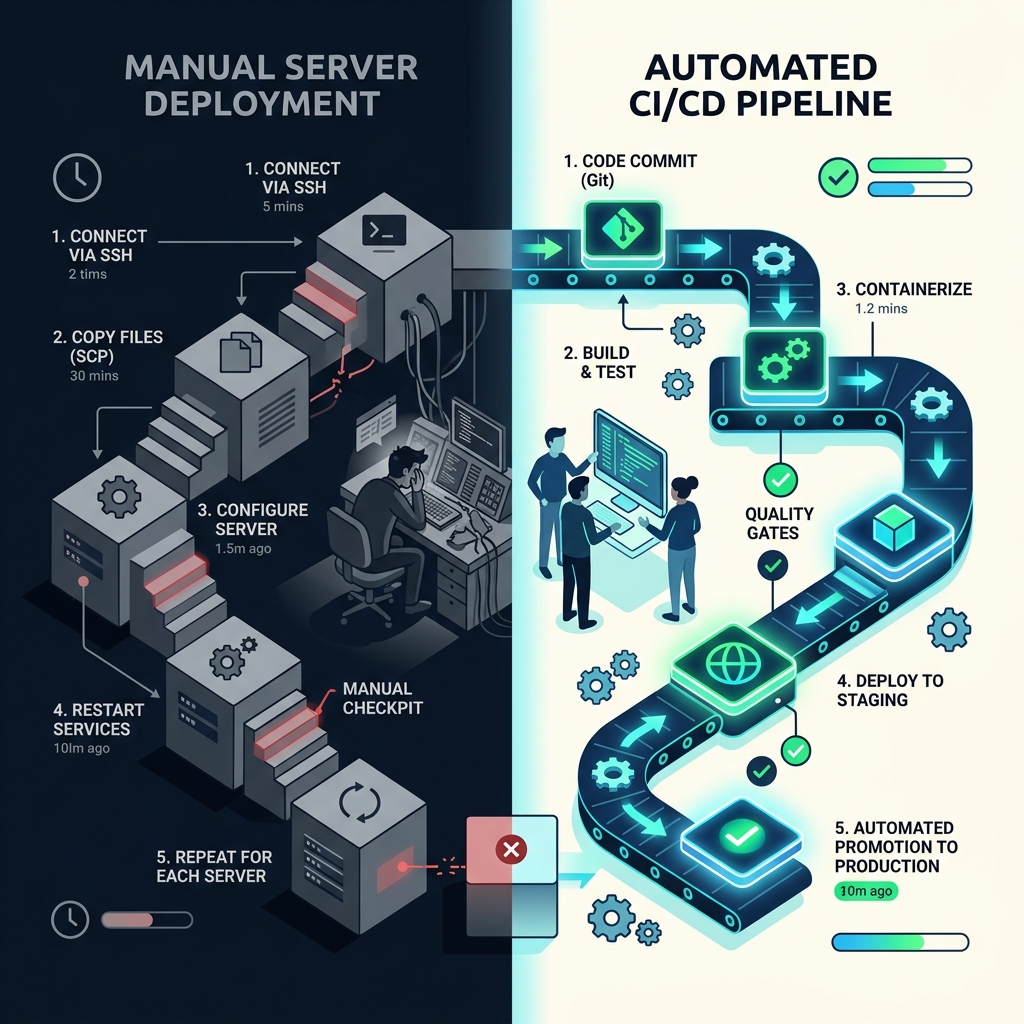
When a company realizes it needs better infrastructure, it faces a choice: hire an in-house engineer, use a Managed Service Provider (MSP), or bring in a devops consultant.
| Feature | In-House DevOps Engineer | Managed Service Provider (MSP) | DevOps Consultant (UseShift) |
|---|---|---|---|
| Setup Speed | Slow (3-6 months to hire) | Moderate | Fast (Immediate start) |
| Cost | High (Salary + Equity + Benefits) | Fixed Monthly Fee | Project-based / High ROI |
| Expertise | Deep but focused on one stack | Broad but often shallow | Deep, specialized, and multi-stack |
| Strategic Impact | Varies by seniority | Low (Maintenance focus) | High (Transformation focus) |
| Retention Risk | High (Turnover 40%+) | Low | None |
| Tool Knowledge | Limited to past experience | Standardized / One size | Cutting-edge / Custom-fit |
An in-house engineer is great for long-term maintenance but often gets bogged down in daily "firefighting" and local office politics. An MSP keeps the lights on but rarely has the incentive to innovate or optimize your costs—after all, they often charge more as your infrastructure grows.
A professional devops consultant is a force multiplier—they build the systems that allow your existing team to work 10x more efficiently. Many of our clients at UseShift find that a three-month consulting project delivers more structural improvement than a full-time hire could achieve in a year. Furthermore, a consultant brings the "Cross-Pollination" of ideas from dozens of different projects, ensuring you aren't repeating the mistakes of others.
Technical Deep-Dive: The DevOps Toolchain
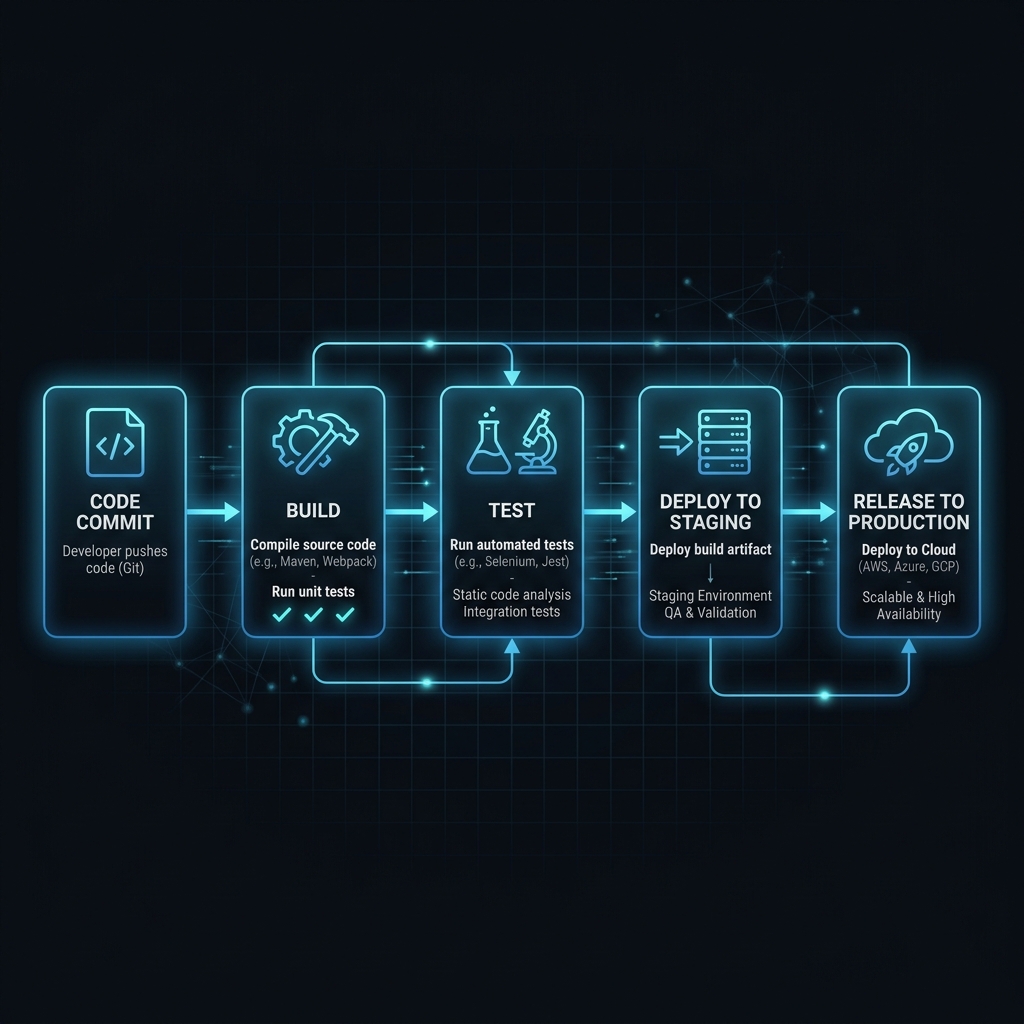
The choice of tools significantly impacts the long-term maintainability of your devops automation. Here is how we evaluate the modern stack in 2026.
↓
[IaC Provisioning] (Terraform/Pulumi)
↓
[Deployment] → [AWS ECS / K8s] → [Observability Stack]
↓
[Autonomous Scaling & Healing Agents]
Cloud Platforms: AWS vs. Azure vs. GCP
While all three major providers offer robust services, the choice often depends on your existing ecosystem. Aws devops remains the leader for its sheer breadth of services, particularly for teams heavily invested in Lambda or ECS. AWS offers the most mature set of APIs, making it a favorite for devops engineering teams that want to automate every aspect of their account.
Azure is the natural choice for enterprises already integrated with Microsoft Entra ID (formerly Active Directory) and Microsoft 365. Their DevOps services (Azure DevOps) are highly integrated, providing an all-in-one solution for boards, repos, and pipelines. GCP (Google Cloud Platform) is favored by data-intensive organizations and those who want the most "pure" Kubernetes experience via GKE (Google Kubernetes Engine).
Containerization & Orchestration: Kubernetes vs. ECS vs. Serverless
Kubernetes (K8s) has won the orchestration war, but it is not always the right answer. K8s is a powerful tool for complex microservices with high scaling needs, but it requires significant operational overhead to manage correctly (even with managed services like EKS or GKE).
For many startups and mid-market firms, we recommend AWS ECS or even ECS Fargate for its "serverless containers" approach. This allows teams to get the benefits of containerization—immutability, portability, and resource isolation—without the overhead of managing a K8s control plane or worker nodes.
Infrastructure as Code: Terraform vs. Pulumi
In 2026, the debate between Terraform and Pulumi is about "Domain Specific Language" (DSL) vs. "General Purpose Programming" (GPP). Terraform's HCL is easy to read and has a massive community-driven provider ecosystem. It is the safe, stable choice for 90% of organizations.
Pulumi, however, allows you to write your infrastructure in TypeScript, Python, or Go. This is a game-changer for teams that want to use standard software engineering practices—like loops, conditionals, and unit tests—within their infrastructure definitions.
Observability and AIOps
In 2026, standard monitoring is dead. We now implement Observability—the ability to understand the internal state of a system from its external outputs. This involves distributed tracing, log aggregation, and real-time metrics. Furthermore, we are increasingly integrating AI agents that can analyze these metrics and suggest infrastructure optimizations in real-time, such as automatically scaling down under-utilized databases during night hours.
Measuring the ROI of DevOps Consulting
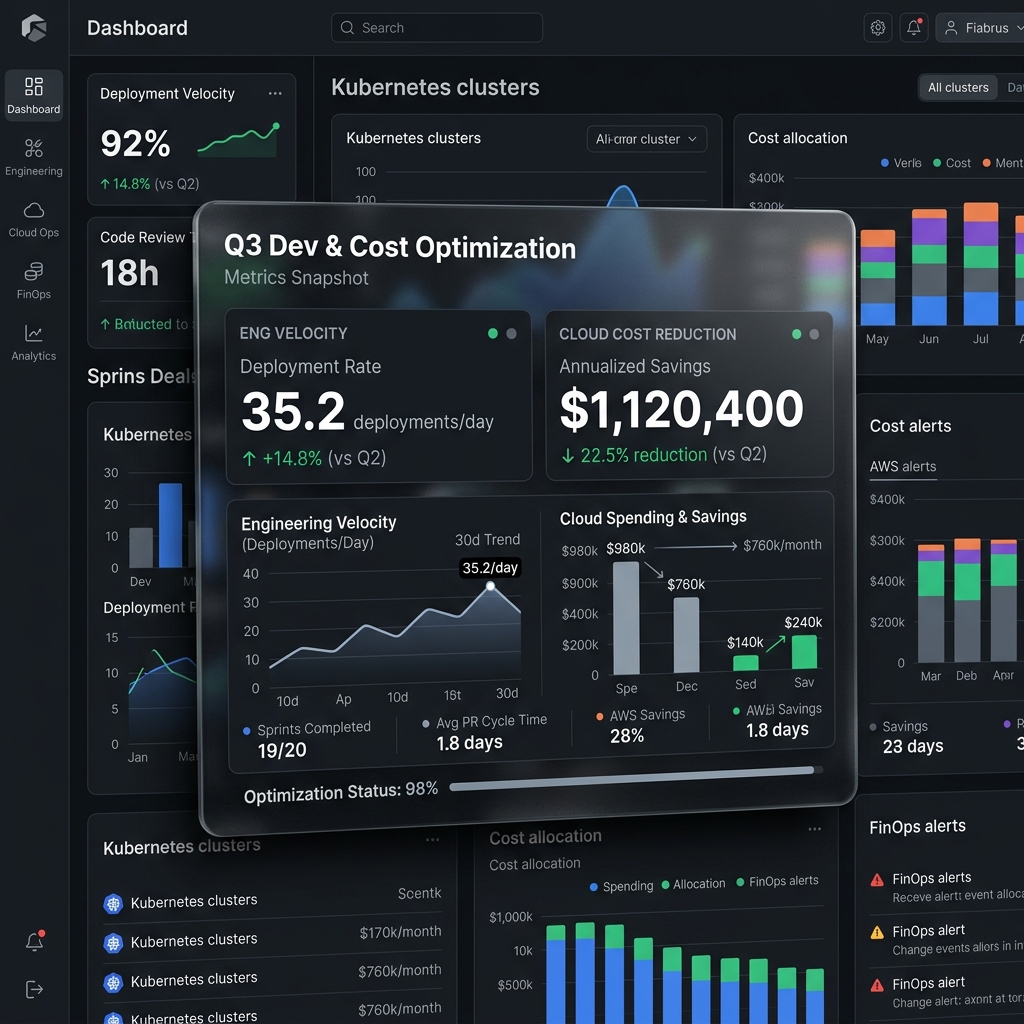
Business leaders often ask: "How do we justify the cost of devops managed services?" The ROI of devops consulting is found in three areas: labor savings, cloud cost reduction, and market velocity.
The DORA Metrics Impact
By improving Deployment Frequency, Lead Time for Changes, MTTR, and Change Failure Rate, we directly impact the bottom line. A lower failure rate means less time spent "fixing bugs" and more time spent "building features."
Labor Savings
If a team of 20 spends 15% of their time on deployment issues, that is ~$500,000 per year in lost productivity. Automating these processes effectively "gives back" those engineers to the business.
Cloud Cost Optimization
Most cloud environments are over-provisioned by 30% or more. A professional devops audit typically identifies 20-40% in immediate cloud savings through right-sizing, reserved instances, spot instance utilization, and automated cleanup. This often pays for the entire consulting engagement within the first quarter.
The "Tools-First" Trap
Many organizations spend thousands on Datadog or Terraform Cloud licenses without changing their underlying processes. Tools alone do not create DevOps. Without a proper devops strategy, you are simply automating your existing inefficiencies. A consultant ensures that your tools support your process, not the other way around.
Case Study: Reducing Build Times by 60% with UseShift
We recently partnered with a mid-market fintech firm that was struggling with a legacy monolith. Their build times were over 45 minutes, and deployments were a "hands-on-deck" event every Tuesday night, often lasting until 2 AM.
The Transformation
We implemented a phased devops roadmap. First, we containerized the application and moved the infrastructure to Terraform. Second, we broke down the monolithic build into parallelized steps using GitHub Actions, allowing the test suites to run in 8 parallel containers. Finally, we implemented a blue-green deployment strategy on AWS ECS, allowing for zero-downtime releases.
"The engineering team reported a 50% increase in job satisfaction because they were no longer spending their evenings managing manual releases. This is the tangible impact of professional devops implementation."
Conclusion: The Future of DevOps is AI-Driven
As we look toward the later half of 2026, the world of DevOps is undergoing another major evolution. We are moving toward "Internal Developer Platforms" (IDP) where developers have a self-service portal to provision their own infrastructure within whitelisted security parameters. AI agents are beginning to take over the role of basic monitoring, not just alerting us to problems but autonomously resolving them.
However, the foundation remains the same. You cannot layer AI on top of a broken manual process. The transition to high-velocity engineering requires a solid strategy, expert implementation, and a commitment to continuous improvement.
Stop fighting your infrastructure and start using it as a catalyst for growth. Whether you need a one-time devops audit or a long-term devops managed services partner, getting expert guidance is the fastest path to engineering excellence.
Key Takeaways
- DevOps consulting transforms infrastructure into a competitive product.
- Automated CI/CD and IaC are the primary drivers of engineering velocity.
- The ROI is measured in labor efficiency, cloud cost savings, and market speed.
Last updated: March 2026 | By Kristaps Jansons