
Is AWS ECS better than Kubernetes in 2026?
For most teams, AWS ECS is the superior choice due to its lower operational overhead, native AWS integration, and ease of use. Kubernetes (EKS) is better for high portability and massive, complex microservices ecosystems that require specific K8s-only tools.
The question is no longer "should we use containers?" but rather "how do we orchestrate them most efficiently?"
In 2026, the choice between AWS ECS (Elastic Container Service) and Kubernetes (EKS) has become the most critical decision in the modern infrastructure stack. As organizations scale their microservices architectures, choosing the right container service is essential for driving your devops in aws strategy forward.
Introduction
While Kubernetes has solidified its position as the industry standard for portable container orchestration, AWS ECS remains the "secret weapon" for teams seeking simplicity, deep AWS integration, and high performance without the operational overhead of a K8s control plane. In this guide, we perform a technical deep-dive into ecs aws, comparing it against its more complex sibling, EKS.
Key Takeaways
- AWS ECS offers native integration and the lowest operational overhead in the AWS ecosystem.
- Fargate provides a serverless compute engine that eliminates virtual machine management.
- Kubernetes (EKS) remains the choice for extreme portability and massive, complex clusters.
What is AWS ECS? (Elastic Container Service)
AWS ECS is a highly scalable, high-performance container orchestration service that supports Docker containers and allows you to easily run and scale containerized applications on AWS. Unlike Kubernetes, which was built as a platform-agnostic tool, ECS was designed from the ground up by Amazon to be natively integrated with the rest of the AWS ecosystem.
Core Components of ECS
- Clusters: A logical grouping of tasks or services.
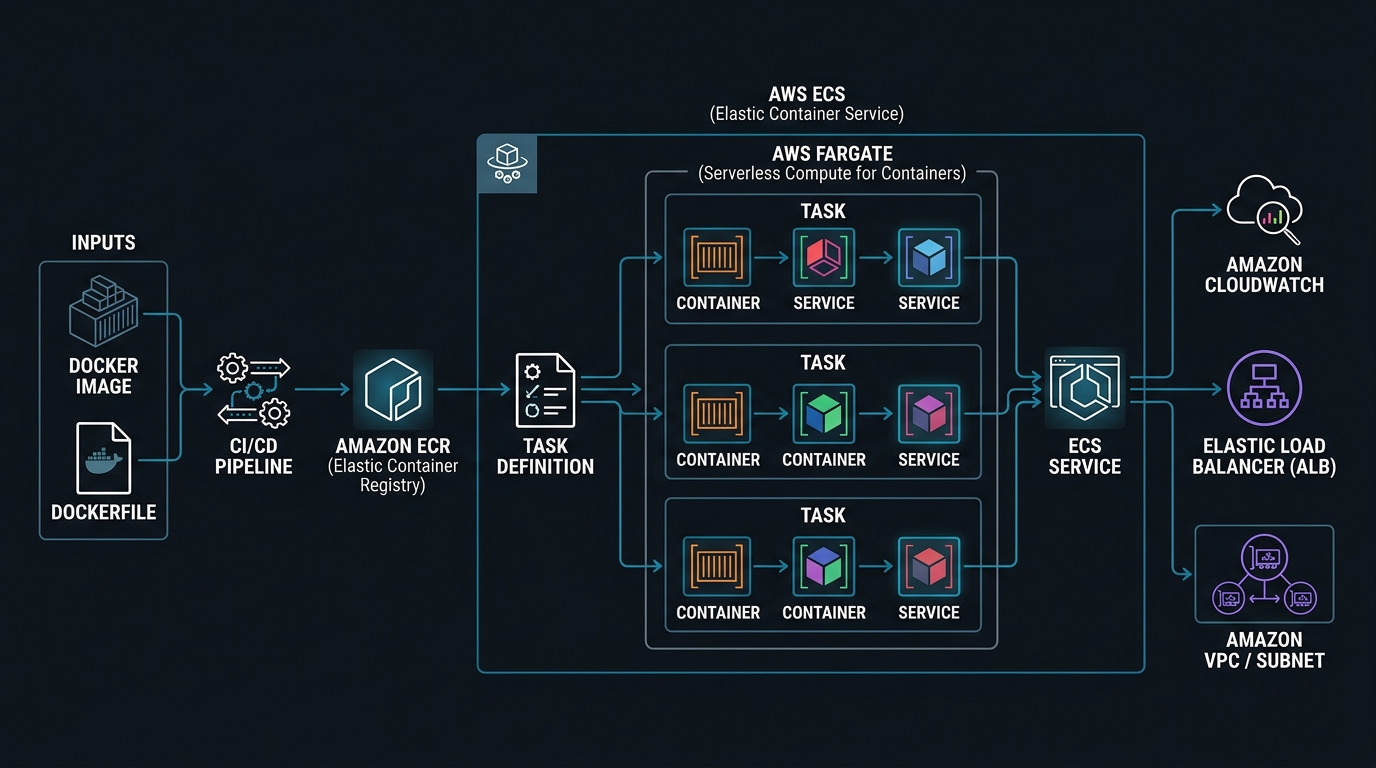
- Task Definitions: A blueprint that describes how a Docker container should be launched.
- Tasks: The running instances of a task definition.
- Services: Maintains a specified number of instances of a task definition simultaneously.
ECS Launch Types: EC2 vs AWS Fargate
The choice between EC2 and Fargate is primarily driven by your need for control versus your desire for a "serverless" experience. In 2026, Fargate has become the default choice for docker on aws due to its "zero-maintenance" philosophy.
ECS on EC2
Full control over the underlying virtual machines. Best for specialized GPU instances or custom OS kernels.
ECS Fargate
Serverless compute for containers. No server management, no cluster scaling, just pay for the CPU/Memory you use.
💡 Pro Tip
In 2026, use ECS Fargate Spot for non-critical, fault-tolerant workloads to save up to 70% compared to standard Fargate pricing. This is ideal for CI/CD runners and batch processing jobs.
AWS ECS vs Kubernetes (EKS): A Technical Deep Dive
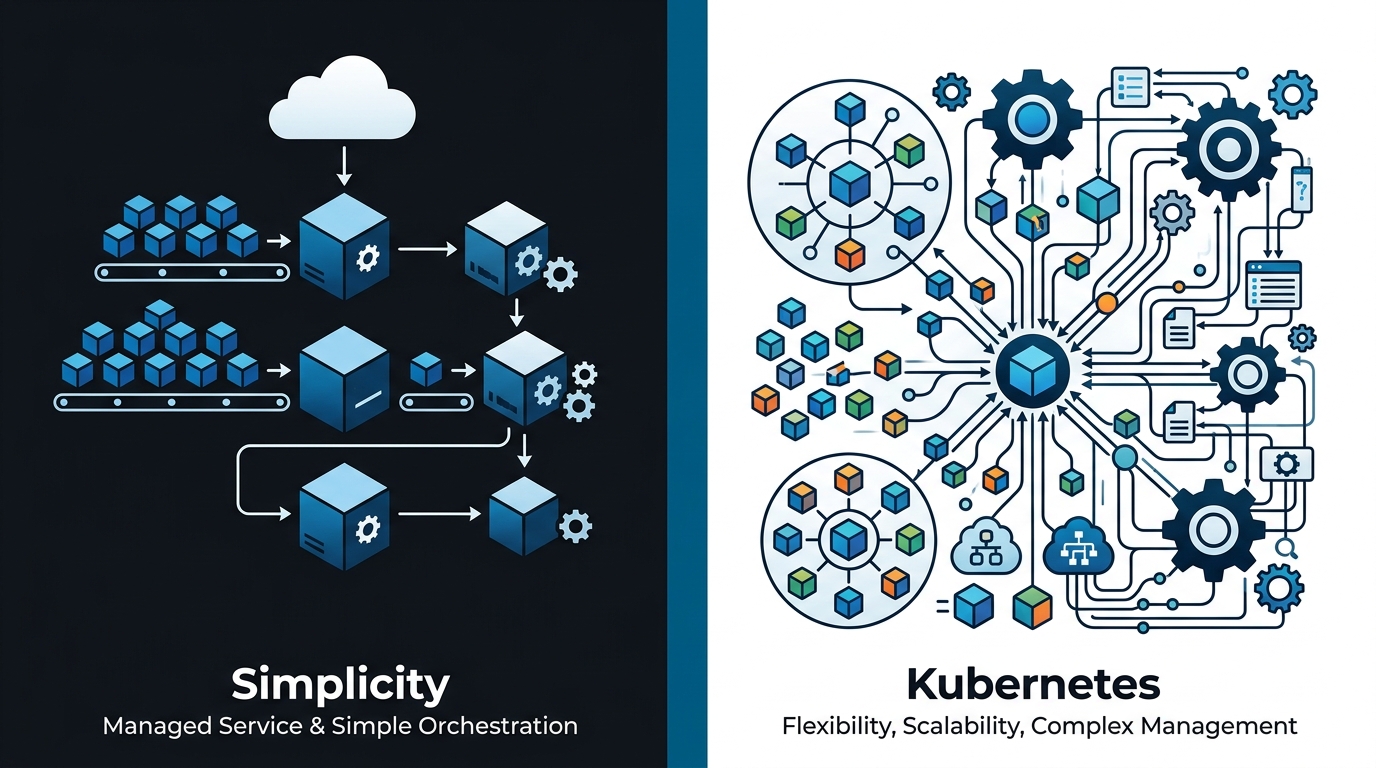
The comparison between aws ecs vs kubernetes is ultimately a choice between simplicity and extensibility. EKS simplifies K8s control plane management, but you are still responsible for the "addons" like CoreDNS and VPC CNI.
| Feature | AWS ECS | AWS EKS (Kubernetes) |
|---|---|---|
| Operational Complexity | Low (AWS Managed) | High (Standard K8s) |
| Portability | Low (AWS Specific) | High (Cloud Agnostic) |
| AWS Integration | Native / Deep | Via Addons / Drivers |
| Learning Curve | 1-2 Days | 2-4 Weeks |
| Networking | AWS VPC Native | VPC CNI (Complex) |
| Scaling Speed | Very Fast (Fargate) | Medium (Karpenter required) |
Getting Started with Docker on AWS
Deploying docker on aws using ECS is streamlined through tools like AWS Copilot. It scan your Dockerfile and generates the necessary AWS resources automatically.

Step 1: Create a Docker Image. A standard Dockerfile is all you need to package your application logic.
Step 2: Push to ECR (Elastic Container Registry). ECR provides secure, private storage for your container images.
Step 3: Define the ECS Task and Service. Use Copilot to deploy a load-balanced service in seconds.
Pricing: ECS vs EKS
Understanding the cost of ecs aws is straightforward, while EKS has a hidden management fee.
ECS Pricing
Zero management cost. You only pay for the EC2 or Fargate resources you consume.
EKS Pricing
Pay for resources PLUS $0.10 per hour per cluster. For granular visibility, EKS users rely on Kubecost.
Conclusion: Which One Should You Choose?
In 2026, the trend is increasingly toward ECS for simplicity and EKS for massive, cloud-agnostic scale. Choose ECS if you want the lowest operational overhead and native AWS depth.
Ready to Optimize Your AWS Infrastructure?
At UseShift, we help organizations design and implement container strategies that actually deliver ROI. Let's discuss your roadmap.
Book a Strategy Call →Key Takeaways
- AWS ECS is the most efficient way to run Docker on AWS with zero management fees.
- Fargate eliminates the need to manage virtual machines for your containerized workloads.
- Choose EKS only if you have extreme portability requirements or a pre-existing K8s footprint.