

What exactly is an app blueprint in software development?
An app blueprint is a detailed technical and strategic plan for a software project. It includes architectural diagrams, UI/UX prototypes, and a development roadmap. It serves as the master plan that ensures technical feasibility and stakeholder alignment before production code is written.
A app blueprint is a technical foundation that defines the architecture, user experience, and growth roadmap of a software project during the discovery phase. This blueprint acts as a high-fidelity map, ensuring that developers and stakeholders are aligned on technical feasibility before writing any production code. It is the single most important document for project success.
Most software projects fail because they start with a "build first, ask questions later" mentality. According to the Standish Group (2025): 66% of software projects experience significant cost overruns or outright failure due to poor initial requirements and architectural planning. This is where professional software blueprinting changes the equation. It shifts the focus from guessing to engineering.
At Shift Team, we treat the blueprint phase as the most important part of the development lifecycle. It isn't just a document. It is a simulated version of your final product. One that identifies bottlenecks before they cost you money. It's about precision.
- The core components that make up a successful app blueprint
- Why the traditional "build first" model leads to project failure
- How AI-powered blueprinting accelerates the discovery phase
- Step-by-step execution for both startups and enterprise systems
- The tangible ROI of investing in architecture before code
1. What is a Blueprint Application in Software Development?
A app blueprint is the evolved version of the traditional software discovery phase. While discovery usually involves a few meetings and a basic Word document, an app blueprint provides a deep technical breakdown. It includes everything from API schemas to cloud infrastructure costs. Think of it as the discovery phase on steroids.
Imagine building a skyscraper. You would never hire a crew and tell them to "start pouring concrete" based on a verbal description of a 50-story tower. You need structural engineering plans, soil samples, and wind-resistance tests. In software, the app blueprint provides that same level of rigor. It is the bridge between a vague idea and a deployable system.
Why the "Build First" Model is Dead
The era of the "Move Fast and Break Things" mantra is over. In 2026, breaking things is too expensive. With the rise of AI-driven development and complex cloud ecosystems, the cost of fixing a fundamental architectural error after deployment is 100x higher than fixing it during the blueprinting phase.
By creating a app blueprint, you create a "source of truth." This document guarantees that if you hire a new developer six months from now, they don't have to guess how the database is structured or why a specific third-party API was chosen. (This is the step most teams skip — and it shows.)
Key Takeaways
- A blueprint is a deep technical breakdown, not just a summary.
- The cost of fixing errors post-launch is 100x higher than in the blueprint phase.
- Blueprinting creates a permanent source of truth for the development team.
2. The Core Components of an Application Blueprint
A successful app blueprint is composed of several interlocking layers. Each layer addresses a specific risk. When you look at application blueprints from specialized B2B SaaS teams, you’ll see they are much more than just UI mockups.
User Personas & Journey Maps
Before you decide on a database, you need to know who is using the app. We define detailed personas and map their journeys. Where do they get stuck? What is the "aha!" moment? This part of the plan guarantees the software actually solves a human problem.
Technical Architecture (The Engine)
This is the heart of software blueprinting. We define the tech stack (e.g., React with Node.js or Flutter for mobile) and the API design. According to Gartner (2025): Companies that use a standardized technical blueprint for apps reduce their maintenance debt by 40% in the first two years. We map out the data flow. This guarantees information moves efficiently between the frontend and the database (like PostgreSQL or MongoDB).
UI/UX Prototypes (The Shell)
We build low-fidelity and high-fidelity wireframes. This allows stakeholders to "feel" the app. It’s easier to move a button in Figma than it is to rewrite a CSS grid in production. Visualizing the flow early prevents expensive rework later.
Scalability Roadmap
Your app might have 10 users today, but what happens when it has 10,000? A app blueprint includes a scalability plan. We identify potential bottlenecks in the architecture and plan for auto-scaling groups, load balancers, and caching layers like Redis.
Budget & Timeline Estimates
The most common question in development is "How much will this cost?" A app blueprint provides a fixed-cost roadmap. Because the technical details are already decided, developers can give accurate estimates instead of "finger-in-the-wind" guesses. It brings predictability to the chaos.
3. Why Every Project Needs a Blueprint Application Phase
The primary goal of software blueprinting is risk mitigation. If you skip this, you aren't saving time; you are just deferring your problems to a later date. It's a trade-off you'll eventually regret.
Eliminating "Feature Creep"
Feature creep is the silent killer of startups. It starts with "Let’s just add one more button" and ends with a bloated, un-usable product. A app blueprint defines the scope. If a feature isn't in the blueprint, it doesn't get built in the MVP. This keeps the project on track and under budget.
Validating Technical Feasibility
Sometimes, a great idea is technically impossible or prohibitively expensive. Maybe the AI model you want to use has a latency of 30 seconds, which would ruin the user experience. By doing technical blueprint for apps first, we catch these issues early. We can find workarounds or pivot the strategy before the heavy investment begins.
Securing Stakeholder Buy-In
Whether you are pitching to a VC or a board of directors, a app blueprint is your best tool. It shows that you have done the homework. It turns a vague concept into a professional engineering plan. Investors trust blueprints; they don't trust "ideas." Shift Team helps founders bridge this gap every day.
4. Blueprint Design App vs. Traditional Discovery
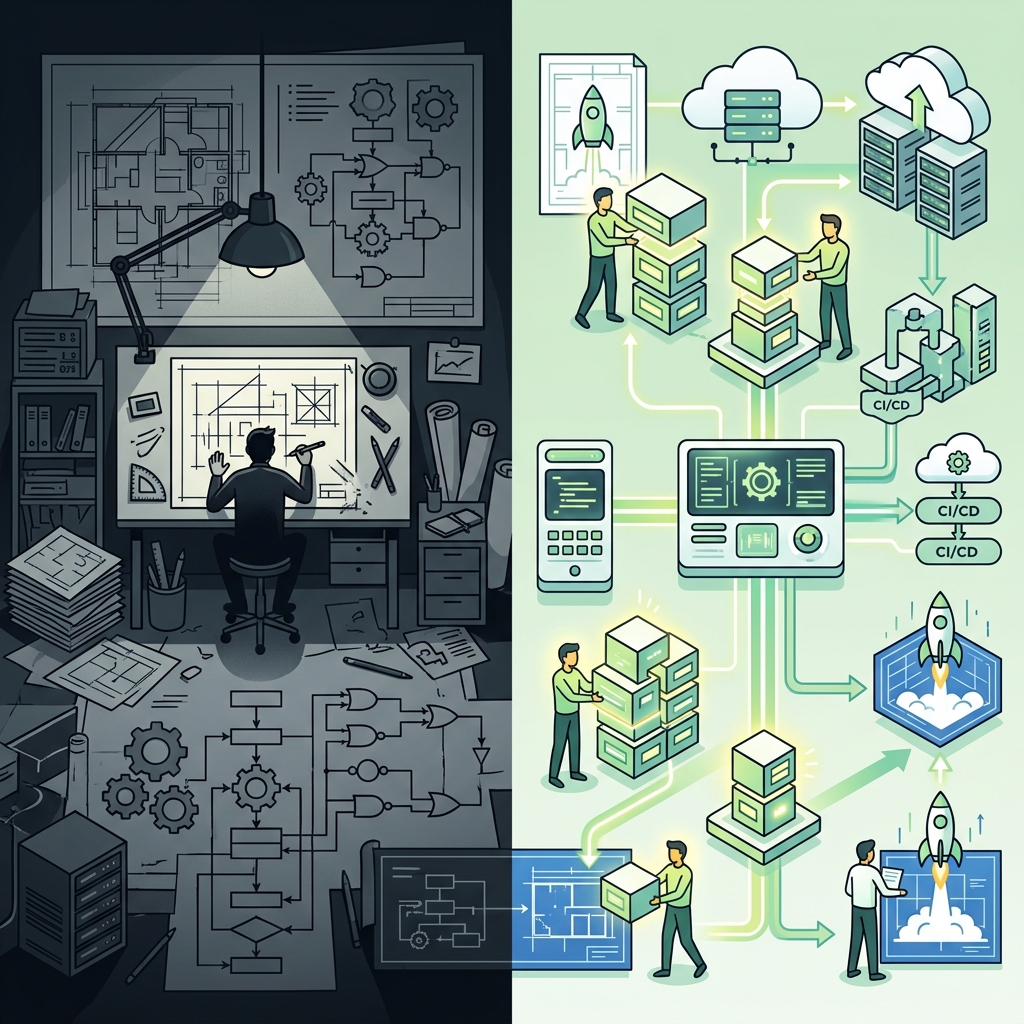
The way we build app blueprints has changed. We no longer rely on manual whiteboarding sessions alone. We use a blueprint design app and AI-driven tools to accelerate the process.
| Feature | Traditional Discovery | AI-Powered Blueprinting |
|---|---|---|
| Speed | 4-6 Weeks | 1-2 Weeks |
| Technical Depth | High-level overview | Deep API & Schema Mapping |
| Risk Assessment | Manual/Intuition-based | AI-Driven Bottleneck Prediction |
| Prototypes | Static Images | Interactive, Data-Linked Mockups |
| Cost Accuracy | +/- 30% | +/- 10% |
Traditional discovery often misses the "edge cases." It focuses on the happy path—what happens when everything goes right. Our app blueprint process uses AI to simulate thousands of user interactions to find where the system might break.
5. Step-by-Step Guide: How to Execute a Blueprint Application
Executing a app blueprint requires a disciplined approach. At UseShift, we follow a five-step process that guarantees nothing is left to chance.
Step 1: Stakeholder Discovery & Vision Alignment
We start by interviewing everyone involved. What is the business goal? Is it to reduce churn? Is it to automate a manual task? We use these insights to set the "North Star" for the project.
Step 2: Technical Audit & Stack Selection
We look at your existing systems. Do you need to integrate with Salesforce? Are you using AWS or Azure? We select the tools that fit your budget and your team’s skills. Do not skip this. Choosing the wrong tech stack can lead to a complete rewrite within 18 months.
Step 3: User Flow & Low-Fi Prototyping
We map out every screen. We don't worry about colors yet. We worry about logic. If a user clicks "Forgot Password," where do they go? How many steps does it take to complete a checkout? We aim for the path of least resistance.
Step 4: AI-Powered Risk Assessment
We run the architectural plan through our AI models. These models are trained on thousands of successful (and failed) software projects. They look for security vulnerabilities, potential "n+1" query problems in the database, and API rate-limiting issues.
Step 5: Final Blueprint Delivery & Handoff
The final result is a complete package. It includes the PRD (Product Requirement Document), the architectural diagrams, the interactive prototype, and the development timeline. You can take this to any development team—including ours—and start building immediately.
6. The Role of AI in Modern Software Blueprinting
At UseShift, AI has changed ai for software architecture from a manual craft into a predictive science. We use AI to generate "Infrastructure as Code" (IaC) templates directly from the blueprint.
For example, when we design a app blueprint for a high-traffic e-commerce site, our AI tools can automatically generate the Terraform scripts needed to deploy that architecture. This guarantees that the "map" and the "territory" are identical.
We also use AI for "Synthetic User Testing." We can create thousands of virtual users to test the UI flows defined in the app blueprint. If the AI users get "confused" by a specific navigation pattern, we know a human will too. We fix it in the blueprint before we build it.
7. Blueprint Application: Enterprise vs. Startups
The scale of application blueprints varies depending on the organization.
Startups: Focus on Speed and MVP
For a startup, the app blueprint is about finding the shortest path to market. It’s about identifying the one "killer feature" and building the leanest possible architecture around it. The goal is to prove the concept and get users.
Enterprise: Focus on Compliance and Security
For an enterprise, the app blueprint is about governance. It includes deep dives into SOC2 compliance, HIPAA data handling, and integration with legacy ERP systems like Salesforce or SAP. According to IDC (2025): Large enterprises that invest in detailed software blueprinting see a 25% improvement in cross-departmental alignment during project execution. It reduces friction.

Detailed Technical Breakdown: The Architecture Layer
To understand why a app blueprint is superior to a simple sketch, we need to look at the "Architecture Layer." This is where we define the relationship between your services.
Database Schema Design
In the blueprint phase, we don't just say "we need a database." We define the tables, the relationships, and the indexing strategy. If your app is social-media focused, we might recommend a Graph database like Neo4j. If it's financial, we stick to a relational system like PostgreSQL. This decision is documented in the software blueprinting phase so that the developers don't make a choice that limits your growth later.
API Strategy
We decide between REST, GraphQL, or gRPC. For most app blueprints, we prefer GraphQL because it allows the frontend to request only the data it needs, which improves mobile performance. We also define the authentication layer (OAuth2, JWT) and the rate-limiting policies to prevent abuse.
Cloud Infrastructure
A app blueprint is incomplete without a cloud map. We specify which AWS services (like Lambda, S3, or RDS) will be used. We estimate the monthly "burn rate" for these services so there are no surprises on your bill.
User Experience (UX) Psychology in Blueprinting
We don't just move pixels; we use behavioral science. During software blueprinting, we apply "Fitts's Law" to guarantee that the most important buttons are the easiest to click. We look at cognitive load—ensuring that we don't overwhelm the user with too many choices on a single screen.
We also plan for "Empty States." What does the app look like when there is no data? Most developers forget this. A good app blueprint guarantees that the first-time user experience is just as polished as the hundredth-time experience.
The "Build vs. Buy" Decision Matrix
One of the most valuable outputs of software blueprinting is the "Build vs. Buy" analysis. Why build a custom chat feature when you can integrate a proven API like Sendbird? Why build a custom billing engine when Stripe exists?
We identify where you should spend your engineering budget for custom logic and where you should use off-the-shelf components. This alone can save a project $20,000 to $50,000 in unnecessary labor. Shift Team helps teams make these hard choices.
Integrating AI Employees into the Blueprint
In 2026, many application blueprints include an "AI Employee" layer. This is a core part of what we do at Shift Team. We don't just build apps; we build autonomous workflows.
When we blueprint a project, we look for manual tasks that can be handled by an AI agent. Maybe it's automated lead qualification or AI-driven content generation. We map these agents into the architecture, defining how they interact with your database and your users. This transforms your software from a simple tool into an autonomous business engine.
For more on how we approach AI architecture, see our guide on AI software development company selection and our deep dive into developing artificial intelligence.
The Blueprinting Process: A Real-World Case Study (2026)
To see the power of a blueprint application in action, consider the case of "AgriLogistics," a mid-sized logistics firm that needed to modernize its aging supply chain management system.
When AgriLogistics first approached the project, their internal team estimated a 12-month development cycle based on a three-page "requirements list." They were about to start hiring developers when we intervened with an software blueprinting phase.
The Blueprinting Discovery
During the first week, we identified a massive gap in their requirements: they hadn't accounted for offline data synchronization for drivers in rural areas. Their "build-first" plan would have resulted in an app that crashed every time a driver entered a low-signal zone.
The Result
By building a technical blueprint for apps first, we designed a "Local-First" architecture using Couchbase for mobile syncing. This changed the entire tech stack before they spent a dollar on development. The final project was delivered in 9 months—three months faster than their original guess—because the developers never had to stop and ask, "How do we handle offline mode?" The app blueprint had already provided the answer.
Common Mistakes in Application Blueprinting
Even when teams decide to create a blueprint, they often fall into several common traps. Recognizing these early is a core part of the Shift Team philosophy.
1. The "Too Vague" Blueprint
A blueprint that says "we will use a secure login system" is useless. A real app blueprint specifies: "We will use Auth0 with OpenID Connect, implementing the Authorization Code Flow with PKCE for mobile clients." Precision is the difference between an engineering plan and a wish list.
2. The "Static Document" Trap
Software is dynamic. If your app blueprint is a PDF that sits in a folder and is never updated, it becomes a liability. We advocate for "Living Blueprints"—documents that are updated as the project evolves. When a technical decision changes during development, it must be reflected back in the blueprint.
3. Ignoring the "Developer Experience" (DX)
Many application blueprints focus only on the end-user. They forget that the developers are users too. If the architecture is so complex that it takes a new engineer three weeks to set up their local environment, the blueprint has failed. We include "DX Guidelines" in our software blueprinting process to guarantee high team velocity.
Security-First Blueprinting: Protecting Your Data from Day Zero
In 2026, security cannot be an afterthought. A app blueprint must be "Secure by Design." We integrate security audits into the blueprinting phase itself.
Threat Modeling
We identify potential attack vectors. Where is the most sensitive data? How can we isolate that data? By doing this in the app blueprint phase, we can implement "Least Privilege" access controls at the architectural level. According to IBM (2025): Companies that implement security during the design phase reduce the cost of a data breach by 58%.
Compliance as Code
For our enterprise clients, the app blueprint includes the compliance requirements for SOC2, HIPAA, or GDPR. We don't just list the rules; we design the technical controls that enforce them. This guarantees that when it comes time for an audit, the software is already compliant by default.

Cost-Benefit Analysis: The ROI of Blueprinting
Many stakeholders are hesitant to spend money on a "planning phase." They want to see code. However, the math in 2026 is clear: software blueprinting is a profit center, not a cost center.
The "Rework" Tax
The average software project spends 40% of its budget on "rework"—fixing things that were built incorrectly the first time. A app blueprint reduces this tax to less than 5%.
Speed to Market
While the blueprinting phase takes 2-4 weeks, it accelerates the actual development phase by 30-50%. Because the "thinking" is already done, the developers can focus purely on "doing." This is how high-growth startups use a blueprint design app to outpace their competitors.
Maintaining Your Blueprint: The Post-Launch Phase
A app blueprint continues to provide value long after the initial launch. It serves as the foundation for V2, V3, and beyond.
Onboarding New Engineers
When you scale your team, the blueprint is your primary onboarding tool. Instead of shadow-following senior engineers, new hires can read the technical blueprint for apps and understand the "why" behind every line of code.
Strategic Pivots
Business requirements change. If you need to pivot your product, the blueprint allows you to see the technical impact of that pivot immediately. You can model the changes in the blueprint design app and see how it affects your database, your APIs, and your costs before you commit to the change.
Deep Dive: Microservices vs. Monolith in Your Blueprint
One of the most critical decisions made during software blueprinting is the choice of architectural style. In 2026, this decision is more nuanced than ever.
When to Choose a Modular Monolith
For 80% of startups, a "Modular Monolith" is the correct choice in the app blueprint. It is easier to deploy, cheaper to maintain, and provides high performance for a single team. We design the blueprint so that different modules (like Billing, Users, and Content) are cleanly separated. This allows you to migrate to microservices later without a full rewrite.
When to Choose Microservices
If your app blueprint is for a massive enterprise project with multiple independent teams, microservices are the answer. This allows each team to move at their own pace. However, it introduces significant complexity in networking and data consistency. We only recommend this in a app blueprint when the scale truly justifies the overhead.
The Human Element: Why AI Cannot Blueprint Alone
While we use a blueprint design app and AI tools, the most important part of the process is the human architect. AI is great at pattern matching, but it lacks "Contextual Wisdom."
An AI might suggest a high-performance database, but it won't know that your lead developer is an expert in SQL and that switching to a NoSQL system would slow the team down. Our software blueprinting process balances technical perfection with human reality. We build plans that your specific team can actually execute.
Conclusion: Don't Code Without a Map
Building software without a app blueprint is like driving across the country without a GPS. You might eventually get to your destination, but you will waste a lot of fuel and take many wrong turns along the way.
The blueprint is your insurance policy. It protects your budget, aligns your team, and guarantees that your final product actually meets the needs of your users. Whether you are a founder building your first MVP or a CTO managing a digital transformation, software blueprinting is the key to predictable success.
UseShift specializes in turning vague ideas into hardened engineering plans. We help you move from the "what if" to the "how to." By focusing on the technical blueprint for apps, we guarantee that your development phase is fast, focused, and free of surprises.
Ready to blueprint your next software success?
Shift from uncertainty to architecture. Build it right the first time with a professional engineering plan.
Start Your Blueprint TodayKey Takeaways
- A software blueprint is your insurance policy against cost overruns.
- Precision in the planning phase accelerates development by up to 50%.
- Building without a blueprint is 100x more expensive to fix post-launch.