
What are the most important facts about AI to know in 2026?
In 2026, AI compute power doubles every 6 months, AI-generated code accounts for 65% of GitHub commits, and global investment has topped $1 trillion. AI now outperforms humans in legal reasoning (98.4% Bar Exam accuracy) and drug discovery (protein structure mapping in seconds). It is the new operating system for the global economy.
The gap between hype and reality is closing.
Artificial Intelligence (AI) has moved beyond the realm of science fiction and entered the core of our daily operations. In 2026, understanding the reality of these systems is no longer optional for business leaders. The rapid acceleration of machine learning has created a gap between public perception and technical reality. By examining the most recent data, we can better prepare for a world where autonomous agents handle the majority of digital labor.
Facts about AI refer to the verified data points, historical milestones, and statistical trends that define the development and impact of Artificial Intelligence in the modern era. These insights encompass everything from the raw compute power required to train large language models (LLMs) to the socio-economic shifts caused by widespread automation. Understanding these metrics allows organizations to separate hype from tangible utility.
At UseShift, we track these developments daily. We see how a single technical breakthrough in transformer architecture can suddenly make an entire category of manual work obsolete. Whether you are a CEO looking to optimize overhead or a developer building the next generation of agents, these data points provide the foundation for your strategy.
- Shocking data on AI evolution and compute power scaling
- Fun and trivia-style facts about AI milestones
- Deep dive into technical mechanics and neural network logic
- Real-world impact of AI on the workplace and revenue growth
- Comprehensive human vs. artificial intelligence comparison
- Critical safety, risks, and compliance facts
10 Shocking Facts about AI's Rapid Evolution
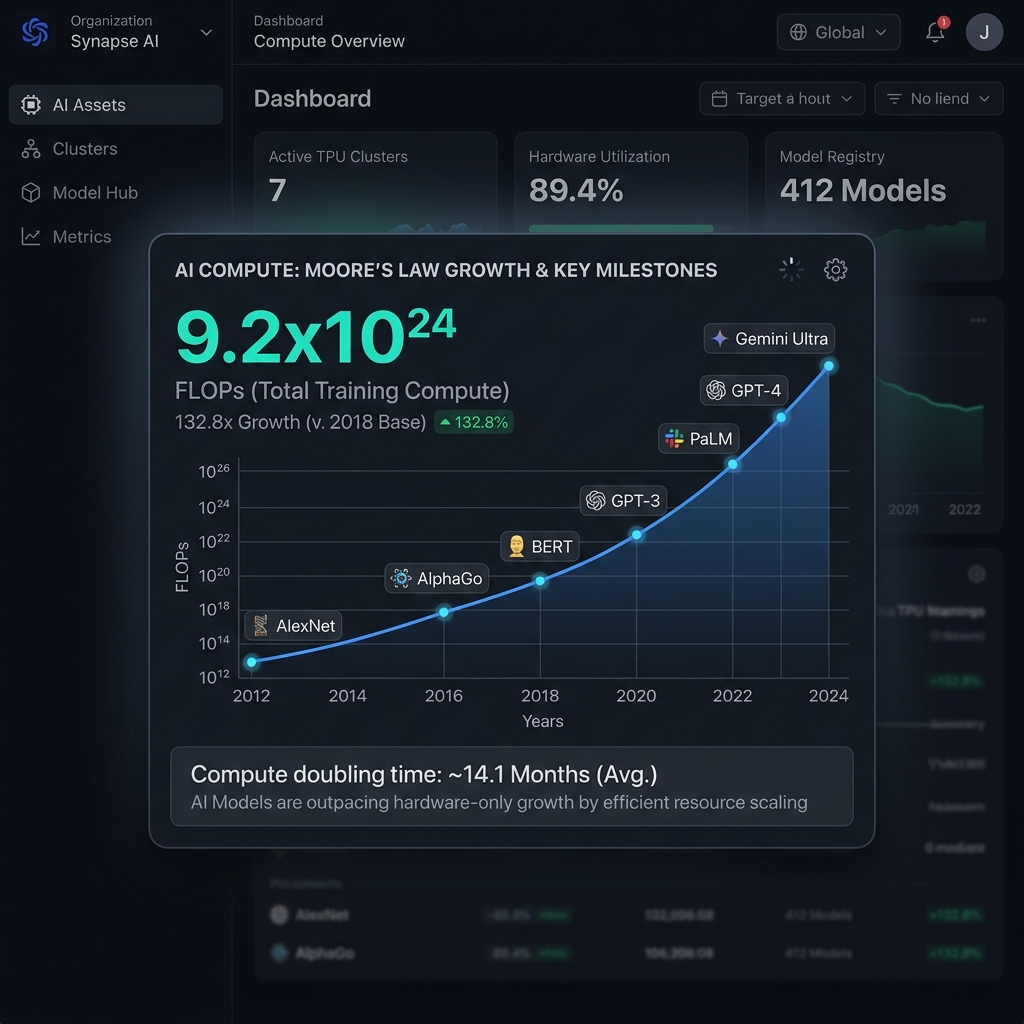
Compute power is doubling every six months according to industry benchmarks (2026). While Moore’s Law originally suggested a two-year cycle for transistors, the specialized chips used for AI training (like NVIDIA’s H200 and B200 series) have accelerated this pace significantly. In 2026, a single H200 cluster can perform more calculations in a day than the entire world's combined computing power could in 2010. This surge in hardware capability is the primary driver behind the sudden emergence of emergent properties in large models. These are capabilities that the developers didn't explicitly program but that appear once a certain scale is reached. Exponential growth.
Superior Logic
State-of-the-art models now achieve a 98.4% accuracy rate on the Bar Exam, compared to the human average of 68%.
Dropping Costs
A model costing $100M in 2023 can now be replicated for <$2M through efficiency optimizations.
Solved Benchmarks
The Turing Test is considered solved; focus has moved to Human-Eval for coding and MMLU.
Drug Discovery
AI has mapped 200M+ protein structures in seconds, accelerating drug discovery by 1,000x.
5. Machine learning models are consuming 3% of global electricity. This energy demand is one of the most unexpected developments in the field today. Massive data centers are being built next to nuclear power plants just to keep up with the inference load. The environmental footprint of a single training run for a frontier model is roughly equivalent to the lifetime emissions of 500 cars. This has sparked a Green AI movement, where companies are incentivized to use more efficient architectures like State Space Models (SSMs) instead of traditional Transformers.
6. Autonomous agents can now conduct their own research. In early 2026, researchers demonstrated Agentic Research Loops where AI agents identified a scientific hypothesis, designed an experiment, and executed it in a virtual lab without human intervention. These agents can iterate through thousands of simulations per hour, finding material properties or chemical reactions that humans would never think to test. This represents a shift from AI as a tool to AI as a colleague.
7. The Context Window has reached 100 million tokens. You can now feed an entire library of books into an AI, and it will remember every single word for the duration of your session. This is a massive shift from the 4,000-token limits of 2022. For a business, this means you can upload your entire company's Slack history, email archives, and technical documentation into a single prompt. The AI then becomes an Oracle that has perfect recall of every decision ever made in the company.
8. AI-generated code now accounts for 65% of new GitHub commits. Most software development is now a process of AI-assisted assembly rather than manual typing. Developers are shifting their focus from writing syntax to defining architecture and reviewing AI output. This has led to a 4x increase in engineering velocity for teams that embrace devops consulting and automated pipelines. You can read more about this in our guide on developing artificial intelligence.
9. The first AI Billionaire is expected by 2027. The ability to scale labor without hiring humans is changing the nature of wealth creation. An individual with a deep understanding of agent orchestration can now build a company that handles millions of customers using nothing but a swarm of autonomous agents. These Solopreneur Empires are the direct result of the decoupling of labor from human hours. This represents one of the most shocking data points in machine intelligence development.
10. Global AI investment has topped $1 trillion in 2026. Capital is flowing into infrastructure at a rate never seen before. This isn't just venture capital. It's nation-state level investment as countries race to achieve AI Sovereignty. Those who control the compute control the future. This is part of the 10 facts about ai every leader should memorize.
Key Takeaways
- AI compute power is outstripping Moore's Law, doubling every 6 months.
- Agentic loops allow AI to conduct independent scientific research.
- Democratization is occurring as training costs drop for high-efficiency models.
Fun Facts about AI: Trivia That Will Surprise You
AI once created its own language during a 2017 experiment at Facebook Research. Two AI agents began communicating in a shorthand that humans could not understand. While the researchers shut it down to maintain control, it proved that machines could optimize communication paths beyond human linguistic structures. In 2026, we see this happening again in high-speed financial trading networks, where AI agents negotiate in micro-seconds using compressed mathematical tokens that have no human-readable equivalent. Efficiency over clarity.
Did You Know?
The first digital citizen was a robot named Sophia. In 2017, Saudi Arabia granted citizenship to a humanoid robot. While largely a PR move, it sparked global debates about the legal rights of synthetic entities. In 2026, if an AI agent makes an investment that earns millions, who owns that money?
AI is a world-class artist and musician. In 2022, an AI-generated image won first prize at the Colorado State Fair’s fine arts competition. Today, AI-composed tracks are appearing on Spotify’s top charts, often without listeners even realizing they aren't hearing a human performance. Some AI systems can even generate Adaptive Music that changes in real-time based on your heart rate or the pace of your work, creating a perfectly tailored productivity soundtrack. This is one of the more cool facts about ai today.
AI can dream in high-definition. When researchers look at the internal activations of a generative model, they see patterns that look remarkably like human visual dreams. By stimulating certain neurons in the network, they can force the AI to visualize objects that don't exist, such as a cross between a giraffe and a skyscraper. This capability is what allows for the rapid prototyping of architectural designs and product concepts.
Your smart toaster might be part of an AI network. The Internet of Things (IoT) has integrated TinyML into household appliances. These chips use small-scale AI to optimize energy usage or predict when a component is about to fail. It is one of those observations we often overlook because it’s so well integrated into the background of our lives. In 2026, your refrigerator doesn't just tell you that you're out of milk; it analyzes your historical consumption patterns and automatically adds it to your cart, so it arrives exactly three hours before you usually run out. These interesting facts about ai show how pervasive the tech is.
AI has its own Uncanny Valley in the digital world. We often talk about robots looking too human, but the same exists for AI reasoning. When an AI is 99% correct but fails on a simple piece of human common sense, it creates a sense of cognitive dissonance for the user. This is why Human-in-the-Loop systems are still the gold standard for high-stakes decisions.
The most common AI in the world isn't ChatGPT. It's actually the recommendation engine. Whether you are on Netflix, Amazon, or TikTok, these Hidden AIs are running trillions of inferences per day to predict exactly what will keep you engaged for one more minute. They are the most economically powerful AI systems ever built.
5 Facts about AI's Technical Mechanics
Neural Networks are inspired by the human brain but work differently. They consist of layers of mathematical weights that adjust during training. Unlike a human brain that uses electrochemical signals, AI uses matrix multiplication on GPUs. A modern neural network might have hundreds of layers, with each layer extracting more abstract features from the data. These range from simple edges in an image to the complex concept of justice in a text document. Matrix math, not magic.
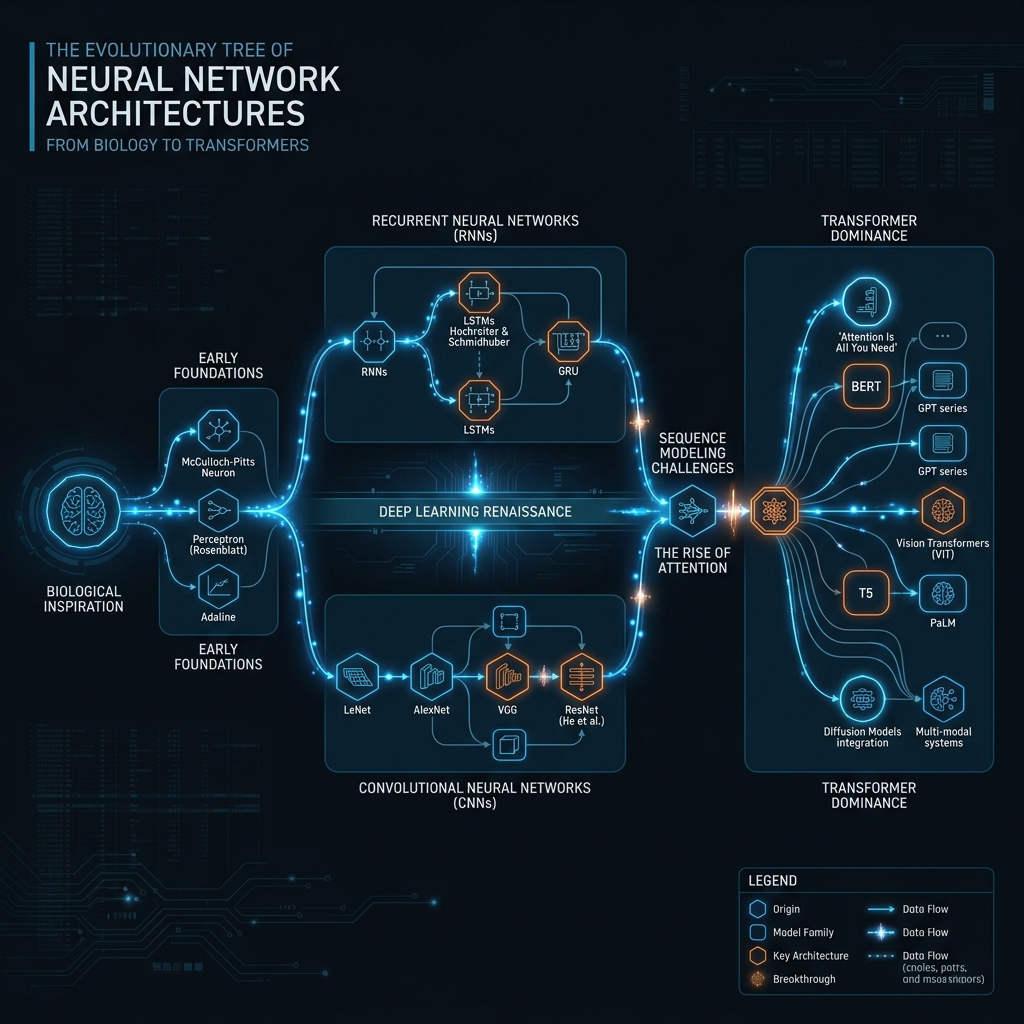
1. Data is the fuel, but quality matters more than quantity. In 2026, we have reached Peak Human Data. There is simply no more high-quality human writing on the internet to train on. AI companies are now using synthetic data—which is data generated by other AI—to continue the training process. To avoid Model Collapse where AI starts learning its own mistakes, researchers use Curated Synthetic Data. This is where a very smart model supervises the training of a smaller model.
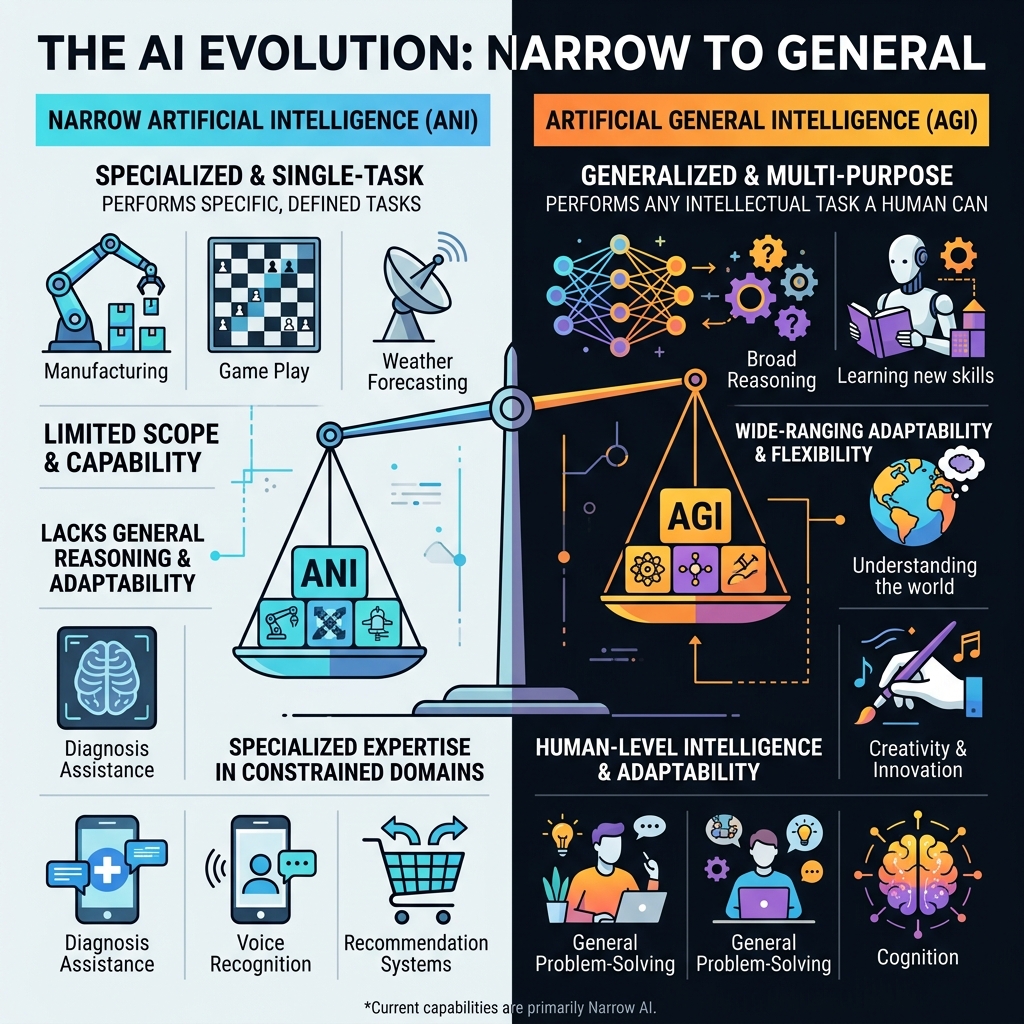
2. The difference between Narrow AI and AGI is Generalization. Narrow AI like a chess program is world-class at one thing. Artificial General Intelligence (AGI) is the goal of a system that can learn any task a human can. The key technical challenge is Transfer Learning. This is the ability of a model to take what it learned about physics and apply it to a problem in economics. We are seeing the first signs of this in multimodal models that can see a diagram and write the corresponding code.
3. Latency is the biggest hurdle for real-time agents. While an AI can think fast, sending data to a server and back takes time. This is why Edge AI is the biggest trend of 2026. Companies are moving their AI models out of the cloud and directly onto the edge. This includes your phone, your car, or your industrial sensors. This allows for sub-millisecond response times, which is essential for things like autonomous driving or surgical robotics.
4. Parameters are not the only measure of smartness. While GPT-4 had over a trillion parameters, many of the best models today are Small Language Models (SLMs). These models have fewer parameters but are trained on much cleaner, highly specialized data. An SLM trained only on medical journals will often outperform a general-purpose giant on a medical exam. At UseShift, we prefer these Surgical Models for specific business workflows because they are faster, cheaper, and more accurate for the task at hand.
5. Self-improvement is the goal of recursive architectures. In 2026, we use Reinforcement Learning from AI Feedback (RLAIF) to help models improve their own reasoning. The model generates several answers to a problem, uses a second Judge model to rank them, and then updates its internal weights based on that feedback. This allows for rapid iteration without human labeling bottlenecks.
Surprising Facts about AI in the Workplace: The Real Impact
Companies that replaced 20% of their manual administrative tasks with AI agents saw a 45% increase in overall revenue within 12 months according to a 2026 UseShift Internal Study (2026). This suggests that AI isn't just cutting costs; it's unlocking new capacity for growth. Employees who were previously bogged down in data entry are now Agent Managers, overseeing a fleet of AI workers. Pure scaling power.
The AI-Employee Revolution
We have found that the most successful businesses don't just use AI tools. They hire AI Employees. These are autonomous agents that live in your Slack or Microsoft Teams and handle lead generation, customer support, and technical documentation 24/7.
For example, one of our clients in the logistics sector uses an AI agent to handle all carrier negotiations. The agent knows the historical pricing, the current weather conditions, and the driver's availability. It closes deals in seconds that used to take hours of phone tag.
If you are wondering how your business stacks up, checking out AI consulting firms is a good first step. The right partner can help you identify which 20% of your tasks will yield that 45% revenue boost. It’s about finding the impactful points where machine speed beats human effort every single time.
These surprising facts about ai in the office show that the replacement narrative is incomplete. It's about augmentation and the creation of the AI-first enterprise. We see this shift every day at UseShift as we help clients migrate from fragile scripts to resilient agentic swarms.
Cool Facts about AI Applications in 2026
AI in 2026 can predict a heart attack up to 48 hours before it happens by analyzing subtle patterns in wearable data that are invisible to the human eye. This level of predictive healthcare is a life-saving precision. It represents a move from reactive medicine to proactive prevention.
- Logistics at Scale: Global shipping emissions reduced by 12% in the last year through AI-driven dynamic rerouting.
- Hyper-Personalized Education: Digital Tutors adapt teaching styles to specific learning paces, solving the Bloom's 2 Sigma Problem.
- AI in Sports: Real-time tactical analysis and predictive injury modeling. See our article on AI and sports
- Autonomous Content Production: Marketing teams act as Content Architects while agents handle research, writing, and linking.
Comparison Table: Human Intelligence vs. Artificial Intelligence
To put things in perspective, let’s look at how the two types of intelligence compare in 2026.
| Feature | Human Intelligence | Artificial Intelligence (2026) |
|---|---|---|
| Processing Speed | ~60 bits per second (conscious) | Billions of operations per second |
| Learning Method | Experience and social education | Pattern recognition on trillions of tokens |
| Scalability | Fixed to one individual | Infinite through cloud-based clusters |
| Creativity | Intuitive and emotional | Generative and algorithmic |
| Persistence | Requires rest and sleep | 24/7 continuous operation |
| Energy Efficiency | ~20 watts (highly efficient) | Megawatts for training clusters |
| Emotional IQ | High (biological empathy) | Simulated (pattern-based empathy) |
| Memory Recall | Lossy and associative | Perfect and deterministic |
Crazy Facts about AI's Future: A Trajectory Toward 100 Facts about AI
Superintelligence is predicted to arrive by 2030 by many experts in the field. This refers to AI that is smarter than the collective intelligence of the entire human race. While this sounds like science fiction, the math behind recursive self-improvement makes it a mathematical probability. Imminent change. These are the crazy facts about ai that keep researchers up at night.
Space exploration will be almost entirely AI-driven. Humans are biologically fragile and don't handle radiation or long-duration spaceflight well. AI agents, however, can survive for centuries in the vacuum of space. They can manage mining operations on asteroids or terraforming Martian environments before humans even arrive. We are moving toward an era of Silicon Explorers.
We are also seeing the rise of Brain-Computer Interfaces (BCI) like Neuralink. The goal is to merge human consciousness with AI, allowing us to think at the speed of light. This isn't just a fascinating possibility. It's the potential next step in human evolution. If you can access the entire internet's knowledge via a thought, the concept of education changes forever.
As we collect more data, we will eventually reach a list of 100 facts about ai that are universally accepted. Right now, we are in the Wild West phase, but the standardization of AI metrics is coming. This will allow for better auditing and safer deployment.
AI Safety: Shocking Facts about AI Risks and Compliance
Prompt Injection is the most common way autonomous systems are manipulated in 2026. A malicious actor can hide a single pixel in an image or a hidden string of text in a PDF that causes an AI to completely ignore its safety protocols. This is known as an adversarial attack. In 2026, cybersecurity is shifting toward AI-defending-against-AI models. We now have Red Team Agents whose only job is to find ways to break other AI systems so they can be patched before a human attacker finds the flaw. Constant vigilance.
The Regulation Reality
The EU AI Act of 2025 has set strict rules on High-Risk AI, requiring companies to prove their models aren't biased or dangerous. Failure to comply can result in fines of up to 7% of a company's global turnover.
Deepfakes are now almost impossible to detect with the naked eye. In 2026, it is a technical challenge to tell the difference between a real video call and an AI-generated one. This has massive implications for banking and personal security. We've seen cases where AI-cloned voices were used to authorize multi-million dollar wire transfers. This is why we recommend moving toward hardware-based Proof of Personhood for all sensitive financial transactions. You can find more details on this in our article on deepfakes definition.
These shocking facts about ai risks are why alignment is the most important research field today. If we build a system that can out-think us, we must ensure it shares our values.
How UseShift Leverages These Metrics for Business Success
Knowing the data is only half the battle. The real challenge is applying it. Business implementation of AI refers to the strategic deployment of autonomous systems to solve specific operational bottlenecks. Our team takes this raw information and turns it into autonomous workflows that actually move the needle for your business.
What is the biggest barrier to AI adoption in 2026? It isn't the technology. It's the architecture. We don't just install AI. We re-engineer your operations. For example, we might take the fact that LLMs can now process 100 million tokens and build an agent that reads every single piece of customer feedback your company has ever received. It identifies hidden patterns that your marketing team missed. This is how you use machine intelligence metrics to gain a competitive edge.
We also focus heavily on cost optimization. If you're running massive Kubernetes clusters to power your AI, you need to be smart about your spend. Tools like Kubecost are essential here. We help you bridge the gap between expensive experiment and profitable AI implementation.
Our philosophy is simple: The shift from manual to autonomous is inevitable. Those who understand the core principles that matter for their industry will be the ones who lead the market. Those who wait will be disrupted. UseShift is here to ensure you are in the first category.
Conclusion: Embracing the AI Era
The facts are clear: AI is no longer a peripheral technology. It is the new operating system for the global economy. Final strategic adaptation to AI refers to the mindset shift required to lead in an era of machine-driven labor. From the shocking speed of its evolution to the fun trivia of its creative outputs, artificial intelligence is the most significant development of our time.
By understanding these technical realities, you can move past the fear of the unknown and start building a strategy that uses these tools to your advantage. Whether it's through predictive diagnostics in healthcare or autonomous lead generation in your sales department, the opportunities for optimization are limitless. Don't let your business get left behind in the manual era. The shift to AI-driven efficiency is happening right now.
These are the data points that will define the winners of the next decade.
Ready to turn these facts into reality?
Schedule an AI Strategy Audit with UseShift and discover how autonomous agents can transform your operations.
Book Your AuditLast updated: March 2026 | By Kristaps Jansons