

What is NVIDIA NemoClaw?
NemoClaw is an enterprise-grade, open-source security and policy wrapper built on top of OpenClaw autonomous AI agents. Using the kernel-level OpenShell runtime (Linux Landlock + seccomp), it enforces zero-trust filesystem, network, and process policies that AI agents cannot bypass — even under a successful prompt injection attack.
- Why raw OpenClaw represents an "apocalyptic" enterprise security risk in 2026
- How NemoClaw's OpenShell runtime sandboxes agents at the OS kernel level
- The technical architecture of the Privacy Router and Nemotron 3 Super 120B model
- A detailed pros-and-cons analysis of the current Alpha release
- Specific recommendations for enterprise IT teams vs. indie developers
- How UseShift can implement NemoClaw-secured workflows for your business
Introduction: The Era of Agentic Computing
The artificial intelligence landscape of 2026 has definitively shifted from passive, prompt-and-response chatbots to persistent, autonomous entities. This inflection point, widely categorized as "agentic computing," is characterized by systems that execute multi-step workflows, interact directly with local file systems, navigate browsers, and engage in autonomous software development. At the center of this paradigm shift is OpenClaw, an open-source, self-hosted framework that has rapidly become the foundational layer for autonomous personal assistants.
The adoption rate has been unprecedented. OpenClaw has earned over 165,000 GitHub stars, drawn over 330,000 community members, and integrated deeply into enterprise platforms including Tencent's WeChat mini-programs, Feishu, and DingTalk. NVIDIA's CEO Jensen Huang drew a historic parallel at the March 2026 GTC conference:
"Mac and Windows are the operating systems for the personal computer. OpenClaw is the operating system for personal AI."
However, granting an autonomous AI agent persistent shell access, direct integration with corporate messaging apps, and durable credentials introduces a catastrophic security risk. The fundamental flaw of raw OpenClaw is what security researchers call its "dual supply chain risk" — untrusted external inputs converging with highly privileged internal execution environments.
In this attack model, threat actors bypass hardened corporate perimeters not by attacking users or infrastructure directly, but by compromising the highly privileged AI agent acting on the user's behalf — which has already inherited permissions across the user's entire digital life. Recent scans found 18,000+ directly exposed OpenClaw instances connected to the public internet, with roughly 15% of community skill repositories containing malicious instructions.
What Is NemoClaw? Enterprise Armor for OpenClaw
NemoClaw is an enterprise-grade, open-source security, privacy, and policy wrapper built entirely around OpenClaw. It is not a competitor or a replacement — it is the trusted middleware that controls the execution environment. Part of the broader NVIDIA Agent Toolkit, NemoClaw maintains full architectural compatibility with existing agent deployments while fundamentally altering how permissions are governed.
| Capability | Raw OpenClaw | NemoClaw-Wrapped OpenClaw |
|---|---|---|
| Security model | Prompt-based behavioral guardrails | Kernel-level OS enforcement (Landlock + seccomp) |
| Filesystem access | Unrestricted (full host access) | Whitelisted paths only, enforced by kernel |
| Network access | Unrestricted outbound | Allowlisted domains only, hot-reloadable |
| Prompt injection risk | Critical — agent can be hijacked | Neutralized — policy is outside agent's reach |
| Audit trail | None | Full SIEM telemetry integration (e.g., TrendAI) |
| Local AI model | External cloud APIs only | Nemotron 3 Super 120B (on-device, private) |
| Deployment | Manual setup | Single command, automatic configuration |
The OpenShell Sandbox: Kernel-Level Containment
At the heart of NemoClaw is the OpenShell runtime — a critical architectural shift from application-layer behavioral safety to infrastructure-layer enforcement. Traditional AI agent frameworks rely on system prompts to instruct the model: "do not read secure files." OpenShell enforces this at the OS kernel level, completely out of the agent's reach. No prompt injection can override a kernel policy.
OpenShell utilizes Linux Landlock, seccomp (secure computing mode), and isolated network namespaces to cage the AI agent. This mirrors the "browser tab" security model — every agent session is isolated, compute resources are strictly limited, and permissions are cryptographically verified before any system call executes.
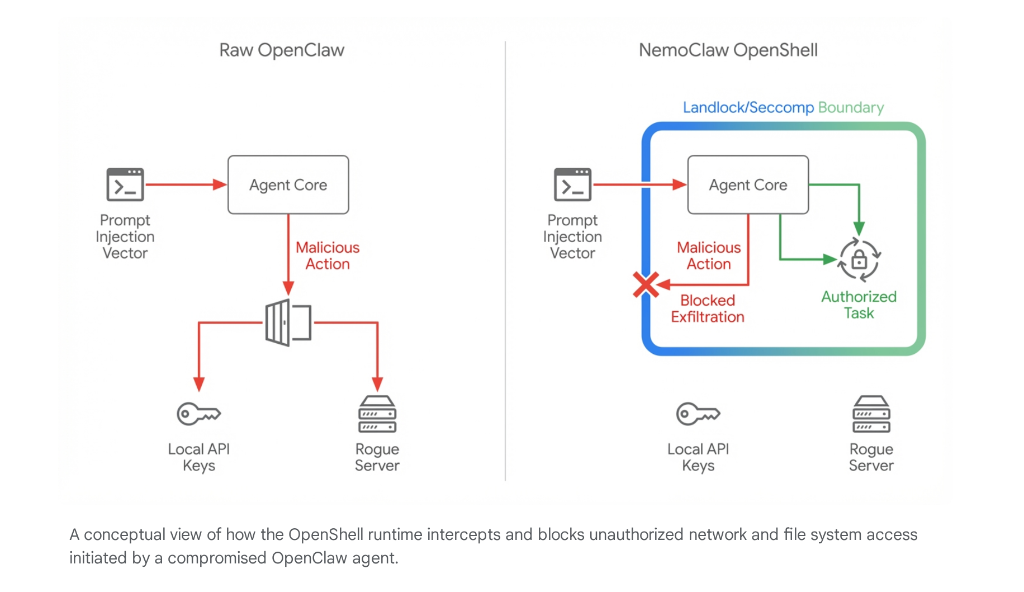
A conceptual view of how the OpenShell runtime intercepts and blocks unauthorized network and file system access initiated by a compromised OpenClaw agent.
Protection is applied across four domains in a defense-in-depth strategy, governed by declarative YAML policies:
| Protection Domain | Implementation | Enforcement Stage |
|---|---|---|
| Filesystem | Prevents reads/writes outside whitelisted paths — protecting API keys, system configs, and source code | Locked at sandbox creation |
| Network | Blocks unauthorized outbound connections — preventing data exfiltration and malware payloads | Hot-reloadable at runtime |
| Process | Blocks privilege escalation and intercepts dangerous system calls via stringent seccomp profiles | Locked at sandbox creation |
| Inference | Reroutes model API calls to controlled private backends based on data sensitivity | Hot-reloadable at runtime |
Defining permissions declaratively via YAML policy files gives IT administrators a unified, version-controlled governance layer that treats security as code. Every agent — coding assistants, research bots, and IT ops automations — runs under identical, auditable runtime policies regardless of host OS.
OpenShell telemetry integrates directly with agentic SIEM systems such as TrendAI, enabling real-time anomaly detection, post-execution forensics, and global threat intelligence scoring for newly downloaded agent skills.
The Privacy Router and Nemotron 3 Super 120B
The second architectural pillar is NemoClaw's intelligent Privacy Router. Enterprise workflows frequently process highly sensitive data — unreleased financial earnings, patient healthcare records, proprietary source code — that cannot legally or competitively be sent to external cloud frontier models. The Privacy Router analyzes each task's context to determine whether it should route to an external NVIDIA Cloud Gateway or be processed entirely on local, isolated hardware.
To power local processing, NVIDIA simultaneously released Nemotron 3 Super 120B — a massive leap in localized agentic reasoning, tailored specifically for complex multi-agent applications like software development and cybersecurity triaging. It features 120 billion total parameters but activates only 12 billion per token during inference through a Mamba-Transformer MoE architecture.
Architectural Innovations That Eliminate the "Thinking Tax"
| Innovation | Mechanism | Enterprise Benefit |
|---|---|---|
| Latent MoE | Projects token embeddings into a compressed latent space before routing to experts | 4x more specialized experts consulted at the same inference cost |
| Mamba-2 Interleaving | Interleaves State Space Models with standard attention layers | 1-million-token context window; linear-time complexity solves 'context explosion' |
| Multi-Token Prediction (MTP) | Forecasts multiple future tokens using shared-weight prediction heads | 3x acceleration on structured tasks like coding and API tool invocation |
| Native NVFP4 Pretraining | Pretrained on 25T tokens natively in 4-bit float format | 4x inference speedup on Blackwell; 4x memory reduction vs. FP16 |
After rigorous post-training across 21 environment configurations and 1.2 million environment rollouts via NVIDIA NeMo Gym, Nemotron 3 Super achieves 85.6% on PinchBench — the highest score of any open model in its class.
Hardware Synergy: DGX Spark & One-Command Deployment

While NemoClaw is hardware-agnostic — running on standard VPS or Docker on macOS, Windows, and Linux — it is heavily optimized for the NVIDIA ecosystem. NVIDIA paired the software launch with the DGX Spark: a compact desktop "personal AI supercomputer" designed to run continuous NemoClaw agents locally.
| Component | DGX Spark Specification |
|---|---|
| Processor & GPU | NVIDIA GB10 Grace Blackwell Superchip — 20-core Arm + Blackwell GPU architecture |
| AI Performance | Up to 1 PetaFLOP of FP4 AI performance (5th Gen Tensor Cores) |
| Memory | 128 GB LPDDR5x coherent unified system memory — supports models up to 200B parameters locally |
| Storage | 1 TB or 4 TB NVMe M.2 with hardware-level self-encryption |
| Networking | ConnectX-7 Smart NIC for 100–200Gbps clustering, 10 GbE, Wi-Fi 7 |
| Form Factor | 150mm × 150mm × 50.5mm, 140W TDP |
| Price | Launched at $3,999; Founder's Edition now ~$4,699 due to enterprise demand |
The final technical pillar is deployment velocity. NemoClaw reduces previously complex multi-container orchestration to a single installation command. The stack automatically configures the OpenShell runtime, downloads and quantizes Nemotron models, and establishes required system-level permissions — making security guardrails completely invisible to the developer.
Why It Matters: NVIDIA's Control Plane Strategy
NemoClaw is a strategic masterstroke by NVIDIA in the enterprise AI landscape. As Microsoft launches Azure AI Agent Service, Anthropic releases coordination frameworks, and Salesforce dominates with Agentforce, all these solutions are largely closed ecosystems that accelerate vendor lock-in.
OpenClaw emerged as the definitive open-source alternative — but lacked the governance required by compliance-heavy industries. NemoClaw bridges this gap without sacrificing open-source flexibility. By open-sourcing the OpenShell runtime, NVIDIA executes a brilliant neutral strategy: they don't own the agentic application layer or the UI. Instead, their grand strategy is to own the control plane.
By acting as the "neutral plumbing" of the agentic economy, NVIDIA ensures that regardless of which foundation model an enterprise chooses (OpenAI, Anthropic, Google, or open-source), the secure execution environment relies on NVIDIA-optimized infrastructure. Enterprises buy NVIDIA hardware not because they're forced to, but because the foundational security software was engineered to run optimally on it.
The Reality Check: Alpha Pros & Cons
Despite the brilliant architecture and NVIDIA's massive engineering resources, NemoClaw is heavily caveated as Alpha software. A rigorous real-world evaluation reveals significant developer friction — the inevitable operational reality of applying military-grade zero-trust security to systems originally designed for unbounded autonomy.
The Pros: Unprecedented Security Posture
- Top-Tier Zero-Trust Security: Linux Landlock and seccomp successfully neutralize even the most sophisticated prompt injection attacks — if an agent is compromised, it simply cannot execute a payload outside its defined namespace, rendering "Delegated Compromise" attacks inert.
- Hardware-Agnostic Flexibility: Containerized deployment avoids cloud vendor lock-in that plagues competing agent platforms.
- Seamless Model Integration: Automated Nemotron 3 Super deployment provides immediate, highly capable local reasoning out-of-the-box, preserving data sovereignty without manual quantization.
- Comprehensive Auditability: Deep SIEM integration turns black-box agent actions into the auditable, compliant security logs required by financial and healthcare regulations.
The Cons: Four Critical Alpha Bottlenecks
Default OpenShell network policies frequently block essential development commands like npm install, cargo build, and external git fetch operations with 403 errors. Developers are forced into a tedious "whitelist-first" policy, manually approving every domain for every new skill.
The default OpenClaw config directory (/sandbox/.openclaw) is often mounted read-only, causing EACCES: permission denied errors when agents try to save state or update long-term memory. Developers must pass custom flags like --dangerously-skip-permissions to work around this.
Security profiles strip standard Linux utilities like ps, pkill, and fuser from the sandbox image. When an agent enters an execution loop, developers cannot terminate hanging processes — forcing a full container rebuild and losing valuable context.
Paradoxically, while internal tooling is aggressively minimal, the overall sandbox image weighs ~2.4GB. Running multiple continuous agent instances rapidly strains standard desktop workstations, making the DGX Spark's 128GB unified memory feel less like a luxury and more like a hard operational requirement.
Who Should Adopt NemoClaw Now?
| Profile | Recommendation | Rationale |
|---|---|---|
| Enterprise IT & Security Teams | Adopt immediately in sandboxed environments | Security benefits are unmatched; use Alpha phase to learn YAML policies and SIEM integrations |
| Teams on DGX hardware | Make NemoClaw the mandatory default | Hardware perfectly suited for multi-agent memory demands; pair with NVIDIA AI Enterprise stack |
| Hobbyists & Indie Hackers | Stick with vanilla OpenClaw for now | Current friction (network whitelisting, volume conflicts, 2.4GB image) severely bottlenecks fast prototyping |
| Compliance-heavy industries (Health, Finance) | Prioritize NemoClaw over any alternative | OpenShell telemetry directly addresses HIPAA/SOC2 audit requirements out-of-the-box |
How UseShift Can Implement NemoClaw in Your Business
NemoClaw represents the future of safe enterprise automation — but its Alpha complexity means the difference between a transformative deployment and a failed pilot often comes down to expertise. This is exactly where UseShift can accelerate your journey.
As an AI automation agency specializing in custom agentic workflows, UseShift can help your organization:
- Design your YAML security policy architecture — defining the exact filesystem, network, and process permissions each agent type needs without blocking legitimate operations.
- Configure the Privacy Router — determining which data classifications route to Nemotron locally vs. NVIDIA Cloud, ensuring data sovereignty for regulated data.
- Integrate OpenShell telemetry into your existing SIEM stack, transforming black-box AI actions into full audit trails that satisfy compliance teams.
- Build custom agent skill libraries — vetted, scanned, and whitelisted for network access, eliminating the 15% malicious-skill risk from public community repositories.
- Make your existing workflows meaningfully faster — automated procurement, contract review, customer escalations, IT ops — all secured and governed by NemoClaw from day one.
Final Verdict
NemoClaw is a critical, necessary evolution for the industry. It represents the maturation of agentic computing from a fascinating, albeit dangerous, open-source experiment into a hardened enterprise utility. While the current Alpha release is marred by the classic tension between strict security and developer usability, the underlying kernel-level architecture is undeniably robust.
By placing the security perimeter at the operating system level and eliminating reliance on easily manipulated prompt-based guardrails, NVIDIA has engineered the definitive blueprint for safe AI automation. As developer friction is systematically resolved in upcoming Beta releases, NemoClaw is uniquely positioned to become the undisputed enterprise standard for autonomous agent deployment — effectively closing the chapter on the AI Wild West.
Key Takeaways
- NemoClaw is a security wrapper — not a replacement — for OpenClaw. It enforces policy at the kernel level via Landlock and seccomp.
- The Privacy Router + Nemotron 3 Super 120B enables fully private, on-device processing of sensitive data without cloud exposure.
- Alpha-state developer friction (network starvation, read-only conflicts, 2.4GB image size) makes it best suited for security-focused enterprise teams right now.
- NVIDIA's real strategy is to own the 'control plane' — ensuring all future AI agents run on NVIDIA-optimized infrastructure, regardless of the chosen foundation model.
- UseShift can implement NemoClaw-secured workflows for your business — making your operations faster while ensuring enterprise-grade governance from day one.