

What is Ember JavaScript?
Ember JavaScript is a highly opinionated, open-source framework for building ambitious web applications. It follows the 'Convention over Configuration' principle, providing a complete toolset—including a powerful CLI, sophisticated router, and integrated data management—designed for long-term maintainability and enterprise-scale stability.
Standardization is the ultimate superpower.
In the rapidly evolving landscape of frontend development, frameworks often come and go like seasonal trends. However, Ember JavaScript has stood the test of time, carving out a unique niche as the definitive "batteries-included" framework for ambitious web developers. Understanding the modern state of Ember in 2026 is crucial for anyone planning long-term, enterprise-grade applications.
Why Choose Ember for Enterprise Applications?
Enterprise applications have specific requirements: they must be scalable, maintainable over decades, and easy for large teams to collaborate on. This is where UseShift's expertise in automation and structured workflows aligns perfectly with Ember's philosophy.
1. Stability Without Stagnation
Ember is famous for its "stability without stagnation" mantra. The core team ensures that new features are introduced via RFCs and that deprecations are handled gracefully. In 2026, the Polaris edition modernizes Ember's internals while maintaining a clear upgrade path for legacy applications.
2. Built-in Productivity Tools
The Ember CLI is the gold standard for command-line tools. It handles everything from asset compilation to generating components and routes, enforcing a uniform project structure essential for large-scale collaboration.
Key Takeaways
- Ember provides a complete, unified environment out of the box.
- The framework prioritizes long-term stability and maintainability.
- Convention over Configuration eliminates decision fatigue for large teams.
Technical Deep-Dive: Under the Hood of Ember 2026
The 2026 edition of Ember is built upon three main pillars: Glimmer VM, Ember Data, and the Polaris architectural shift.
Glimmer VM: The Performance Engine
The Glimmer VM separates the static and dynamic parts of your templates, compiling them into highly optimized bytecode. At runtime, the VM updates only the specific parts of the DOM that have changed, bypassing the need for expensive virtual DOM diffing.
Ember Data: Mastering State at Scale
Ember Data is a full-scale data management solution, handling complex relationships and caching out of the box. Its identity map ensures data consistency across your entire application.
Advanced Routing Dynamics
Unlike many modern JavaScript frameworks where routing is treated as an afterthought or requires third-party plugins, Ember’s router is a first-class citizen built directly into the core framework. In 2026, the Ember Router has evolved to seamlessly support asynchronous data loading, route-level code splitting, and advanced state serialization. When building enterprise-grade applications, the URL should act as the ultimate source of truth, enabling end-users to bookmark, share, and return to exact application states without losing context. Ember strictly enforces this paradigm, automatically managing promise resolution before a route transitions, completely eliminating the jarring loading spinners and layout shifts that plague lesser-structured single-page applications (SPAs).
Furthermore, Ember’s routing architecture includes built-in support for nested routes, which allows developers to build complex master-detail interfaces effortlessly. As the user navigates deeper into the application hierarchy, Ember intelligently mounts and unmounts child components while preserving the state of the parent routes, drastically reducing memory overhead and improving the perceived performance of the application.
Strict Architectural Patterns (The "Ember Way")
A common critique of unopinionated frameworks is that architectural decisions are left entirely to the development team, which frequently leads to "framework fatigue" and completely unmaintainable codebases over a multi-year lifecycle. Ember’s "Convention over Configuration" approach ensures that whether a developer joins an Ember project in Berlin or New York, the directory structure, the testing commands, and the core methodologies remain completely unified. In 2026, the introduction of the Polaris Edition has further modernized these conventions, embracing native JavaScript classes, decorators, and modern module syntax, while strictly enforcing best practices. This strictness significantly reduces the cognitive load during code reviews and drastically accelerates developer onboarding times for enterprise teams.
Component Architecture and Glimmer Integration
The component model in Ember 2026 has been heavily refined. Emphasizing top-down data flow and clear separation of concerns, modern Ember components (often referred to as Glimmer components) strictly separate their arguments (passed data) from their internal state. This prevents obscure two-way data-binding bugs that notoriously complicated older web applications. Developers can now rely on built-in native DOM elements and modifiers, drastically reducing the reliance on bloated wrapper components simply to bind event listeners. While web components are powerful, some enterprise systems still require the raw performance of a native graphical interface for heavy data processing.
Ember.js vs. React vs. Vue: A Modern Comparison
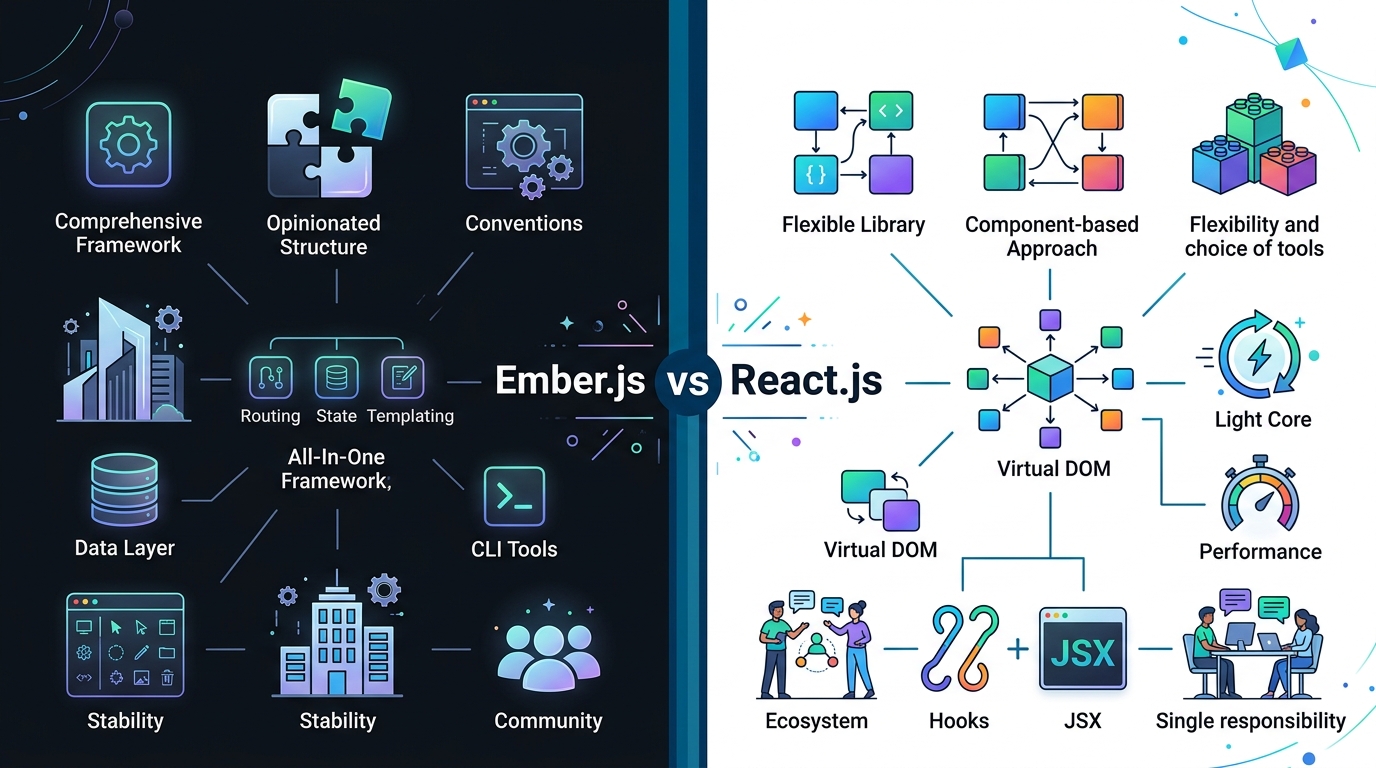
| Feature | Ember.js (2026) | React (19+) | Vue.js (3.x) |
|---|---|---|---|
| Core Philosophy | Convention over Configuration | Small Core, Massive Ecosystem | Balanced & Flexible |
| Learning Curve | Moderate (standardized) | High (fragmentation) | Gentle |
| Data Layer | Ember Data (Built-in) | External (TanStack, etc.) | Pinia / Vuex |
| Routing | Built-in (Sophisticated) | External (React Router) | Official (Vue Router) |
| Enterprise Fit | Maximum (Stability) | High (Community) | Moderate |
Testing in Ember: The Gold Standard
Ember includes a comprehensive testing harness out of the box, covering acceptance, integration, and unit tests with a single toolset.
// Example Acceptance Test
test('user can log in successfully', async function(assert) {
  await visit('/login');
  await fillIn('#username', 'kristaps@useshift.org');
  await click('[data-test-login-button]');
  assert.strictEqual(currentURL(), '/dashboard');
});
Case Study: UseShift Dashboard Migration
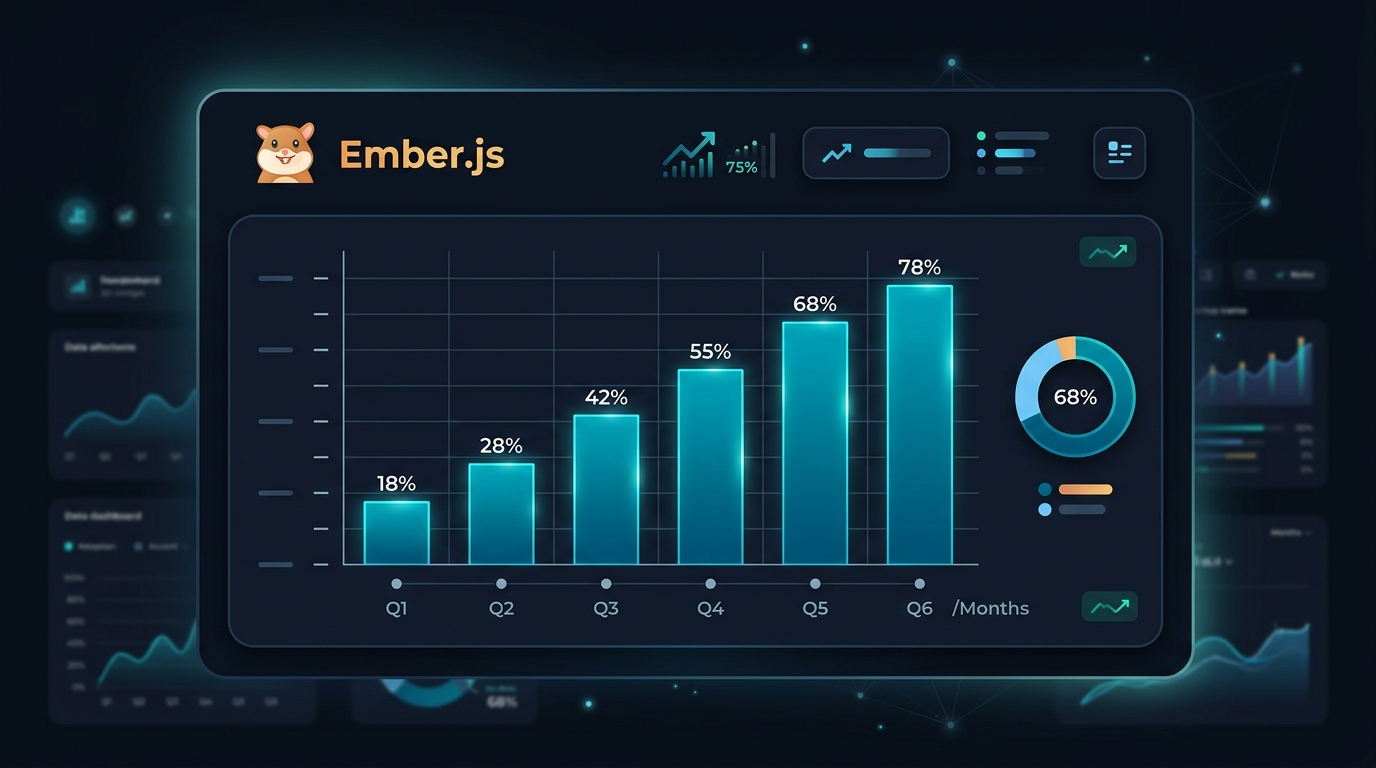
We recently migrated our internal AI-management dashboard to Ember 2026. The results were transformative, reducing maintenance overhead by 30% and significantly speeding up developer onboarding.
Enterprise Security and Compliance Capabilities
Security cannot be an afterthought when building software for the finance, healthcare, or government sectors. Ember’s conservative, strictly-governed core makes it one of the most secure frontend frameworks available in 2026. Because Ember relies heavily on its own templating language (Handlebars) rather than raw innerHTML injection, it inherently protects applications against Cross-Site Scripting (XSS) attacks. Handlebars automatically escapes all output by default, forcing developers to explicitly bypass security checks using specialized helpers if they truly intend to render unescaped HTML. Additionally, Ember strictly enforces Content Security Policy (CSP) compliance right out of the box. In modern enterprise environments, complying with strict CSP headers is mandatory, and Ember’s build pipeline is engineered to generate compliant, secure asset bundles without requiring massive manual configuration overrides or unsafe inline script executions.
Beyond XSS protection, Ember's community actively monitors and patches vulnerabilities through a highly organized security strike team. When a CVE (Common Vulnerabilities and Exposures) is discovered, the Ember security team works closely with enterprise partners to issue backported fixes for multiple older Major and Minor versions. This LTS (Long Term Support) release cycle provides a massive safety net for large organizations that cannot afford to rewrite their entire frontend application every eighteen months simply to stay secure. This predictability is a vital business asset, allowing technical leads to plan secure software lifecycle updates years in advance.
Robust Type Safety with TypeScript
In 2026, TypeScript is no longer optional for serious enterprise software. Ember has embraced TypeScript from the ground up, offering first-class types for core framework constructs, routing, and data models. The combination of Ember's strict conventions with TypeScript's compile-time static analysis creates an impenetrable fortress against runtime regressions. When upgrading a framework or refactoring a deeply nested component tree, TypeScript ensures that developers immediately catch missing arguments, incorrect data payloads, and undefined properties before the code even reaches a staging environment. The Glint language server uniquely extends this type of safety directly into Ember's HTMLBars templates, providing true end-to-end type safety that spans from the database all the way to the generated DOM nodes.
Advanced Performance Optimization Techniques
A common misconception regarding Ember.js is its bundle size. Historically considered a "heavy" framework, the modern 2026 Polaris architecture effectively shatters this myth. Through aggressive tree-shaking methodologies and exact component resolution, the Ember CLI now strips dead code with surgical precision, resulting in drastically reduced initial payload sizes. But true web performance goes far beyond just measuring the kilobytes of JavaScript sent over the wire.
Ember excels in "Time to Interactive" (TTI) metrics on complex, heavy-DOM pages. Through a mechanism known as "FastBoot," Ember applications can be completely server-side rendered (SSR), delivering fully styled and populated HTML to the client instantly. FastBoot eliminates the agonizingly slow "white screen of death" associated with client-side rendering. For search engine optimization (SEO), this is an absolute necessity, as web crawlers can immediately parse the static HTML content without waiting for extensive JavaScript payloads to execute.
Additionally, modern developers utilize Ember's built-in support for Service Workers to implement advanced caching layers and true Offline-First architectures. By intelligently precaching critical application routing shells and dynamically caching specific Ember Data API requests, enterprise web applications can remain fully functional—or gracefully degrade—when a user experiences poor network connectivity. This resilience is what transforms a standard web page into a true Progressive Web Application (PWA).
The Power of the Addon Ecosystem
An application framework is only as powerful as its ecosystem. The Ember addon ecosystem is uniquely robust compared to competing frameworks. Because of Ember's firm conventions, third-party libraries (Addons) integrate seamlessly into the build pipeline without requiring complex webpack or rollup configurations from the consumer. Running a simple command like ember install ember-power-select not only pulls down the dependency but automatically injects the necessary components, styles, and testing helpers globally into the project. This plug-and-play architecture prevents large organizations from continuously reinventing the wheel for common UI patterns.
Some of the most critical addons in the 2026 landscape include comprehensive testing harnesses, advanced state management tools, animations via Ember-Animated, and deep integrations with modern CSS architectures like Tailwind CSS. The strict quality control enforced by the Ember documentation and standardized testing suites means that when an addon is published, developers can trust that it will not completely break their application upon the next minor framework upgrade.
Strategic Migration to Ember.js 2026
For organizations looking to escape the relentless churn of smaller, fragmented libraries, migrating to Ember is a strategic long-term investment. The process often begins by auditing the existing application state and isolating the core domain logic from the fragile UI components. A highly recommended approach is the "Strangler Fig" pattern, where small, isolated routes or micro-frontends are migrated to Ember one at a time, allowing the legacy application and the new Ember application to coexist during the transition phase.
During this migration, leveraging tools from UseShift can drastically reduce the required manual labor. By automating the translation of component hierarchies and establishing robust CI/CD pipelines right from the start, a massive enterprise transition can become completely manageable. Furthermore, training the development staff on Ember’s unique "Convention over Configuration" philosophy is paramount. Once an engineering team understands the underlying Ember paradigms, their total velocity frequently doubles, easily off-setting the initial costs of the migration.
Conclusion
Ember JavaScript remains a titan in the world of frontend development. Its commitment to conventions, stability, and developer productivity makes it the ideal choice for ambitious projects that need to scale.
Key Takeaways
- Ember's stability without stagnation is unmatched for long-term projects.
- The Glimmer VM provides top-tier performance for complex UIs.
- UseShift helps organizations leverage these powerful tools through AI-driven automation.
Ready to take your enterprise application to the next level? Partner with UseShift today.